To rank in Perplexity, build a strong SEO foundation, let PerplexityBot crawl your pages, and publish clear, well-sourced answers backed by a presence on authoritative sites and communities. Ranking in Perplexity means becoming one of the numbered sources Perplexity cites in its answer to a question.
Perplexity ranks content by retrieving passages from its own index, scoring them for relevance, clarity, authority, and freshness, and then choosing which sources to cite, a process that differs from ChatGPT's Bing-based search and Gemini's link to Google. The groundwork comes first (indexable pages, open PerplexityBot access, a list of target questions, and a citation baseline), followed by six steps: SEO foundation, crawler access, well-sourced answers, semantic structure, presence on authoritative sites, and monitoring.
Crawler blocks, outdated facts, unsourced claims, buried answers, and thin pages keep sites out of Perplexity, and lasting visibility takes months of authority building even when a new page is cited quickly. Local service businesses gain from Perplexity's cited provider and cost answers and can bring in professional help when crawl problems or competitor citations persist, before ranking connects to brand mentions, Perplexity answers, and the comparison with ChatGPT. The first section defines what ranking in Perplexity means.
What Does It Mean to Rank in Perplexity?
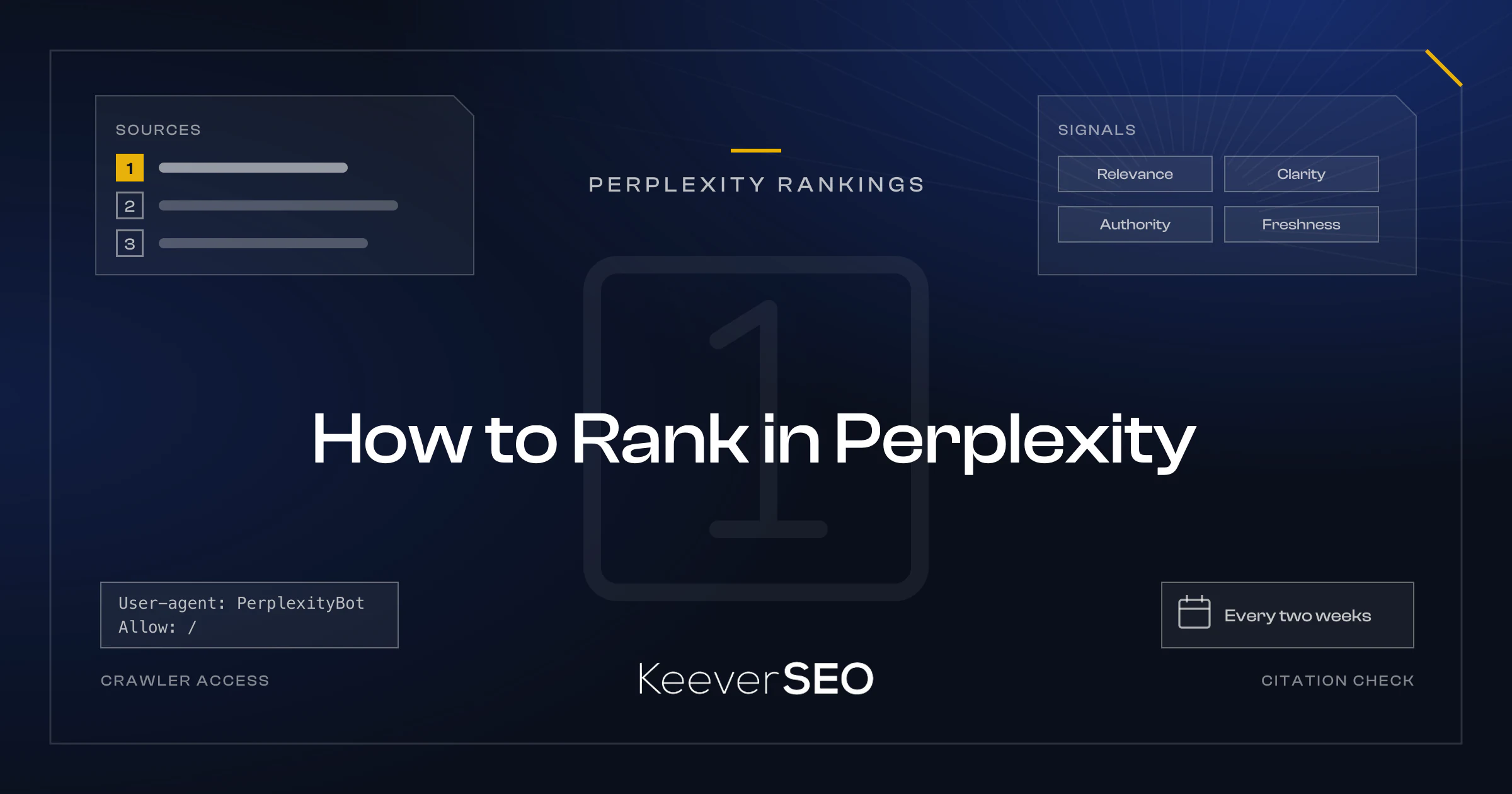
Ranking in Perplexity means a webpage appears as one of the numbered sources cited in Perplexity's answer to a user's question. Perplexity writes a single answer from several sources instead of showing a traditional list of search results.
A page's citation position shapes its visibility, since sources listed first draw more attention, although the order changes from one question to the next. Perplexity can cite the same page again in follow-up answers, and steady citations across related questions show broader visibility than a single appearance.
How Does Perplexity Rank Content?
Perplexity ranks content by retrieving relevant pages from its search index, scoring their passages against the user's question, and choosing the sources it cites in the written answer. The passages that answer the question most directly and most credibly win the numbered citations.
Perplexity shows the chosen sources as numbered citations, so readers can open the supporting evidence. The signals behind that choice, and the way they differ from ChatGPT and Gemini, are covered below.
Which Signals Does Perplexity Weigh When Ranking Sources?
The signals Perplexity weighs when ranking sources are listed below:
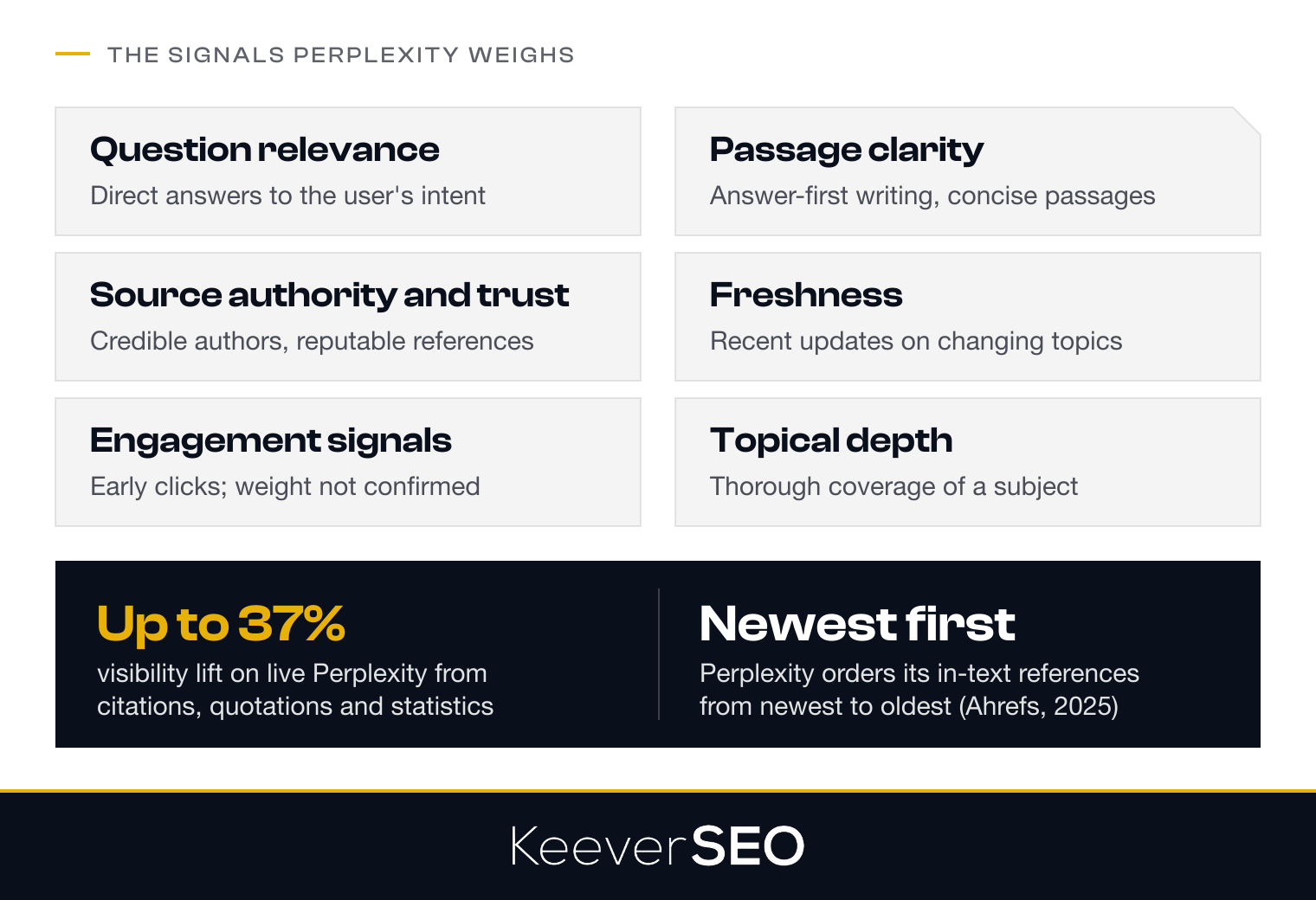
- Question relevance: pages that answer the user's intent directly beat pages that mention the topic in passing.
- Passage clarity: answer-first writing, descriptive headings, and concise passages are easy to extract and cite.
- Source authority and trust: credible authorship, reputable references, and corroborating mentions support reliability.
- Freshness: recent updates carry more weight on changing topics such as prices, statistics, and product details.
- Engagement signals: early clicks and community discussion appear to influence visibility, although Perplexity has not confirmed their weight.
- Topical depth: thorough coverage of a subject gives Perplexity more relevant passages for related questions.
Perplexity has not published a ranking-factor list, so the evidence comes from outside research. An analysis of Perplexity's infrastructure by Metehan Yesilyurt describes a three-layer machine learning reranker, manual lists of authoritative domains, and early clicks shaping long-term visibility, according to "How Perplexity ranks content: Research uncovers core ranking factors and systems" by Danny Goodwin, Search Engine Land, August 2025, which flags the research as unverified. Content changes can move the results: adding citations, quotations, and statistics raised visibility by up to 37% on live Perplexity, according to "GEO: Generative Engine Optimization" by Pranjal Aggarwal and colleagues, KDD 2024. Recency matters too, since Perplexity orders its in-text references from newest to oldest, according to "New Study: AI Assistants Prefer to Cite 'Fresher' Content (17 Million Citations Analyzed)" by Ryan Law, Ahrefs, July 2025.
How Does Perplexity's Ranking Differ From ChatGPT and Gemini?
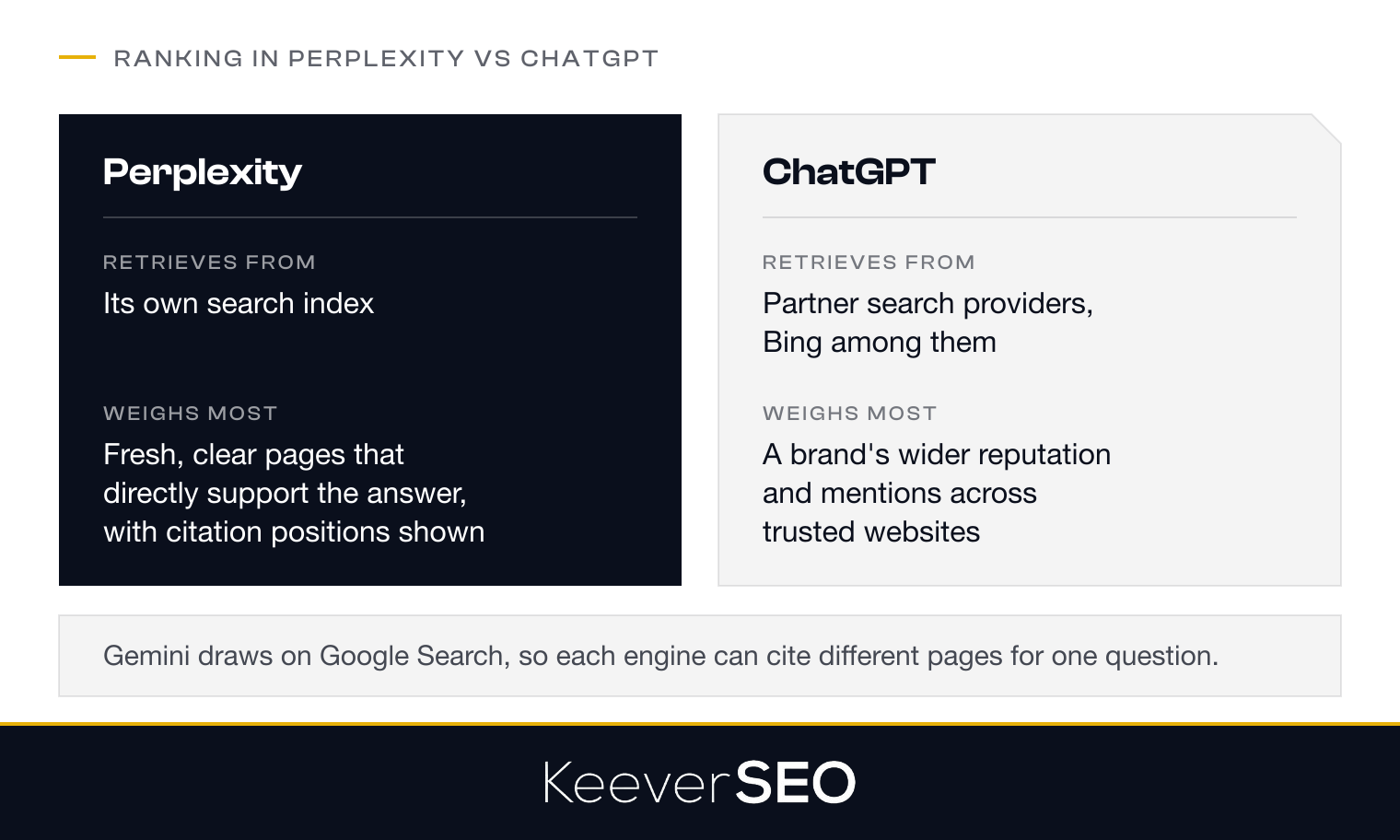
Perplexity's ranking differs from ChatGPT and Gemini because Perplexity retrieves from its own search index and cites sources in almost every answer. Clear, current passages from trustworthy sources qualify a page for those citations.
ChatGPT search sends queries to partner search providers, Bing among them, and leans on brand mentions across the web, while Gemini draws on Google Search and Google's index. Each platform can therefore cite different pages for the same question.
What Do You Need Before Trying to Rank in Perplexity?
The prerequisites for ranking in Perplexity are listed below:
- Indexable pages: target pages load, contain readable text, and carry no noindex directives.
- Open PerplexityBot access: robots.txt, firewalls, CDNs, and bot-protection settings let the crawler through.
- A list of target questions: customer questions about services, products, pricing, comparisons, and local providers.
- A citation baseline: each question tested in Perplexity, with the cited sources, citation positions, and brand mentions recorded.
With the prerequisites in place, the six steps below improve Perplexity visibility.
How Do You Rank in Perplexity?
To rank in Perplexity, follow six steps: build a strong SEO foundation, allow PerplexityBot to crawl your pages, write clear and well-sourced answers, structure pages for semantic clarity, build presence on authoritative sites and communities, and monitor your citation visibility.
The six steps help Perplexity find, read, and trust the content. The process starts with the SEO foundation, because fast, crawlable pages with clear topic coverage are what every later step builds on.
1. Build a Strong SEO Foundation
To rank in Perplexity, start with a strong SEO foundation: fast, indexable pages reachable through standard HTML links. Good visibility in traditional search supports discovery, but it does not guarantee a Perplexity citation.
Descriptive internal links connect related pages, and a group of in-depth resources covers each subject. A clear site structure shows search systems how pages relate to each other, which helps Perplexity find the right passage for each question.
2. Allow PerplexityBot to Crawl Your Pages
To rank in Perplexity, allow PerplexityBot to reach your pages, because Perplexity can only cite what its crawler can read. An explicit robots.txt rule grants the access:
User-agent: PerplexityBot
Allow: /
PerplexityBot is "designed to surface and link websites in search results on Perplexity" and is not used to crawl content for AI foundation models, and robots.txt changes can take up to 24 hours to take effect, according to "Perplexity Crawlers" in Perplexity's documentation, accessed November 2026. Firewall, CDN, and bot-protection settings need a separate check, since they can block the crawler even when robots.txt allows it. Important answers, headings, and evidence belong in server-rendered HTML so the crawler can read the page without running JavaScript.
3. Write Clear, Well-Sourced Answers
To rank in Perplexity, write clear, well-sourced answers: a direct answer near the top of each section, followed by concrete facts, figures, dates, and definitions. Pages that answer first give Perplexity a passage it can lift into its response.
Each claim should name the organization, study, or publication behind it and link to the original source. Expert quotes need a named person and role, and they should back the page's own explanation rather than replace it, so Perplexity finds concise, traceable passages to assess and cite.
4. Structure Pages for Semantic Clarity
To rank in Perplexity, structure pages so each passage matches a question: question headings such as "How much does a roof repair cost?", a direct answer at the start of each section, and short passages that make sense on their own.
Lists and tables make steps, comparisons, prices, and specifications easy to scan. Consistent names for the business, products, services, and locations help readers and search systems identify each entity, and Article, Organization, or LocalBusiness schema that matches the visible content adds clarity without guaranteeing a citation.
5. Build Presence on Authoritative Sites and Communities
To rank in Perplexity, build a presence on authoritative sites and communities, because independent sources give Perplexity outside information about a business. The strongest mentions come from industry publications, useful answers on Reddit and industry forums, accurate review-platform profiles, and expert roundups and comparison guides.
Community answers should share first-hand experience and disclose the business affiliation. Business names, services, locations, and descriptions should match across review platforms, so Perplexity connects every mention to the same business, although Perplexity publishes no authority score or weighting for off-site signals.
6. Monitor Your Perplexity Visibility
To rank in Perplexity over time, monitor visibility by testing the same target questions on a schedule and recording which pages Perplexity cites. A fixed set of 15 to 30 customer questions, tested every two weeks, keeps the results comparable. The monitoring routine is listed below:
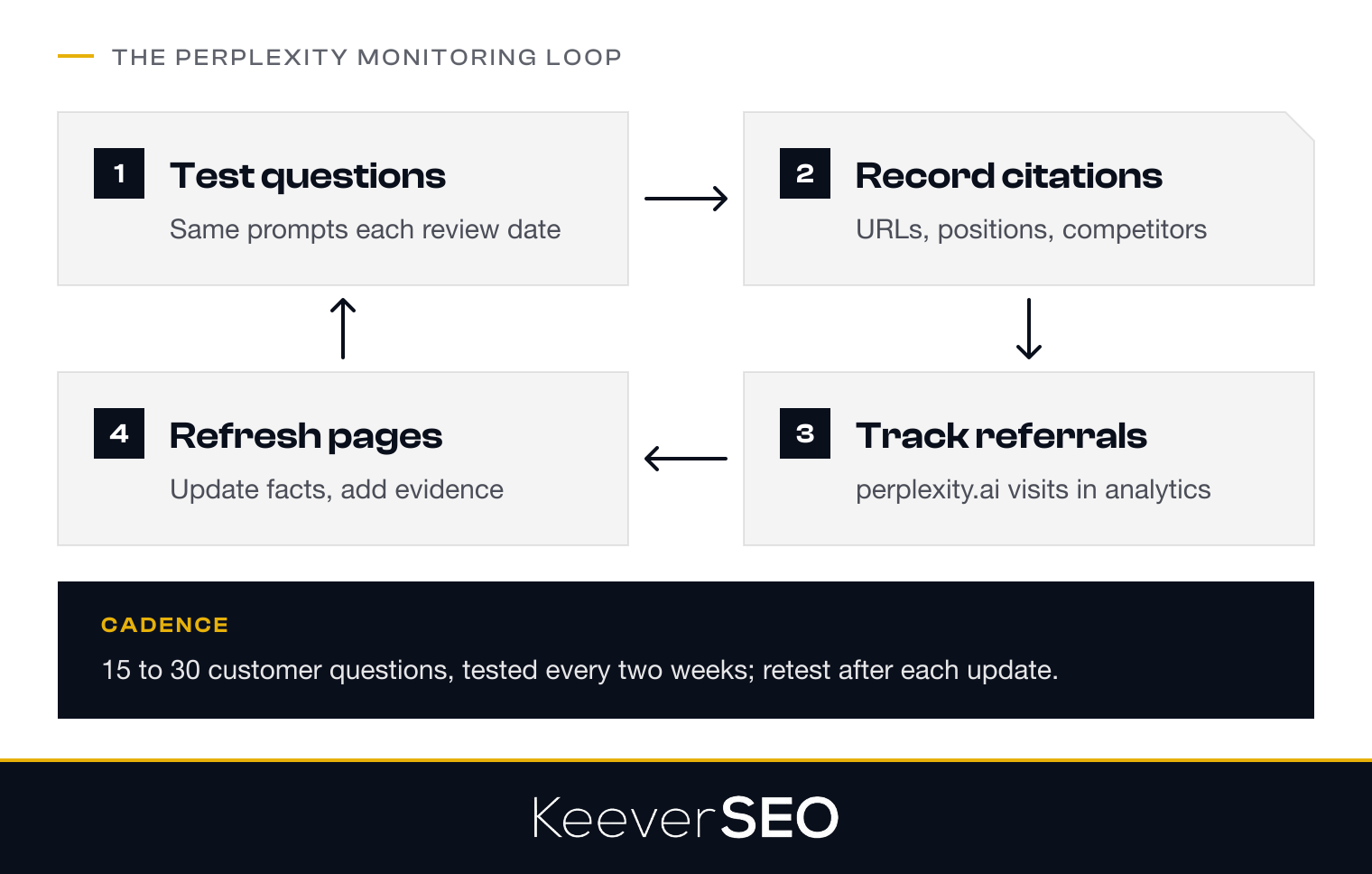
- Test target questions: run the same prompts in Perplexity on each review date.
- Record citations: log the cited URLs, their numbered positions, and competitor sources.
- Track referral traffic: filter analytics for perplexity.ai referrals and compare visits with the citation log.
- Refresh declining pages: update outdated facts, add evidence, and move answers higher when citations drop.
Perplexity citations change between searches, so referral traffic supports citation tracking rather than replacing it. Each page needs a retest after a meaningful update to measure the change.
Which Mistakes Keep Pages From Ranking in Perplexity?
The mistakes that keep pages from ranking in Perplexity are listed below:
- Blocking PerplexityBot: a restrictive robots.txt rule, firewall, or bot challenge stops PerplexityBot from reaching the page.
- Publishing outdated content: old statistics, expired prices, and obsolete recommendations make a page less useful for current questions.
- Making unsourced claims: unsupported statements and unattributed data give Perplexity little evidence to cite.
- Burying the answer: long introductions hide the relevant passage, so the answer belongs near the top.
- Publishing thin pages: generic, shallow content lacks the detail, examples, and evidence a full answer needs.
- Ignoring page structure: dense text, vague headings, and inconsistent terms make information harder to match with questions.
- Building no presence beyond the website: without independent mentions on publications, review platforms, forums, and roundups, outside trust signals stay weak.
How Long Does It Take to Rank in Perplexity?
Ranking in Perplexity takes anywhere from days to months: Perplexity's real-time search can cite a newly crawled page within days or weeks, while steady visibility for competitive questions builds over several months of authority, topical depth, and corroborating mentions. No published study measures a reliable time to a first Perplexity citation, so any fixed range is an estimate rather than a benchmark.
Should Local Service Businesses Optimize to Rank in Perplexity?
Yes, local service businesses should optimize to rank in Perplexity alongside Google and ChatGPT, because Perplexity cites sources when people compare local providers, services, costs, and reputations. A cited business gains visibility at the moment buyers research their options.
Accurate service-area details, clear pricing and process explanations, trustworthy reviews, and mentions on community and industry sites strengthen that visibility. The same improvements support discovery across other AI answer engines and traditional search.
When Does Ranking in Perplexity Need Professional Help?
Ranking in Perplexity needs professional help when technical or competitive problems keep a business out of the citations for its core services. A specialist can investigate crawler or firewall settings, work out why competitors appear as sources, and plan authority building beyond the business website.
An expert audit reviews PerplexityBot access, current citations, answer-first content, and off-site mentions. Ongoing support then tracks citation positions, monitors referral traffic, and updates pages when visibility falls.
How Does Keever SEO's AI Optimization Service Rank Businesses in Perplexity?
Keever SEO's AI optimization service ranks businesses in Perplexity through a citation audit that records current brand mentions, cited pages, competitor visibility, and gaps in content, technical SEO, and entity authority. The audit guides the work on PerplexityBot access and on answer-first content for each target question.
Keever SEO then builds authority through relevant publications, directories, forums, and communities. Ongoing citation tracking records the question, the cited page, and the source position, so the team can refine the pages Perplexity passes over.
How Does Ranking in Perplexity Connect to Mentions and Answers?
Ranking in Perplexity connects to brand mentions and answers because all three come from the same signals: crawler access, relevance, clarity, freshness, and source trust. Perplexity picks relevant passages for its numbered citations, while authoritative pages can lead it to name a brand directly in the answer. The three questions below cover brand mentions, Perplexity answers, and how Perplexity works.
How Do You Get Your Brand Mentioned in Perplexity?
To get your brand mentioned in Perplexity, build authority with clear, well-sourced content and structured data that identifies the brand. Genuine mentions in Reddit discussions, customer reviews, and reputable industry websites, with business details that match across every profile, give Perplexity outside sources that name the brand.
How Do You Appear in Perplexity Answers?
To appear in Perplexity answers, answer the questions your audience asks with clear, self-contained passages near the top of each page. Verifiable facts and credible sources back each answer, and regular tests of the target questions show whether Perplexity cites the page and where.
What Is Perplexity AI and How Does It Work?
Perplexity AI is a cited answer engine that searches the web and turns the results into a conversational response. Perplexity searches in real time, selects relevant passages, and attaches numbered citations linking each claim to its source.
How Does Ranking in Perplexity Compare With Ranking in ChatGPT?
Ranking in Perplexity depends more on Perplexity's own index, fresh pages, and sources that directly support the answer, while ranking in ChatGPT depends more on Bing-based results and brand mentions across trusted websites. Perplexity shows its cited sources prominently, so citation position is visible to every user, and it favors clear, current pages. ChatGPT visibility rewards relevant sources too, but a brand's wider reputation carries more weight there.
What Is the First Step to Rank in Perplexity?
The first step to rank in Perplexity is confirming that PerplexityBot can crawl your website. Robots.txt, firewall rules, and bot-protection settings all need to let the crawler reach your pages.
Once access is confirmed, test a fixed set of target questions in Perplexity and record the sources and citation positions in each answer. The crawl check and the citation baseline together start the full process of ranking in Perplexity.