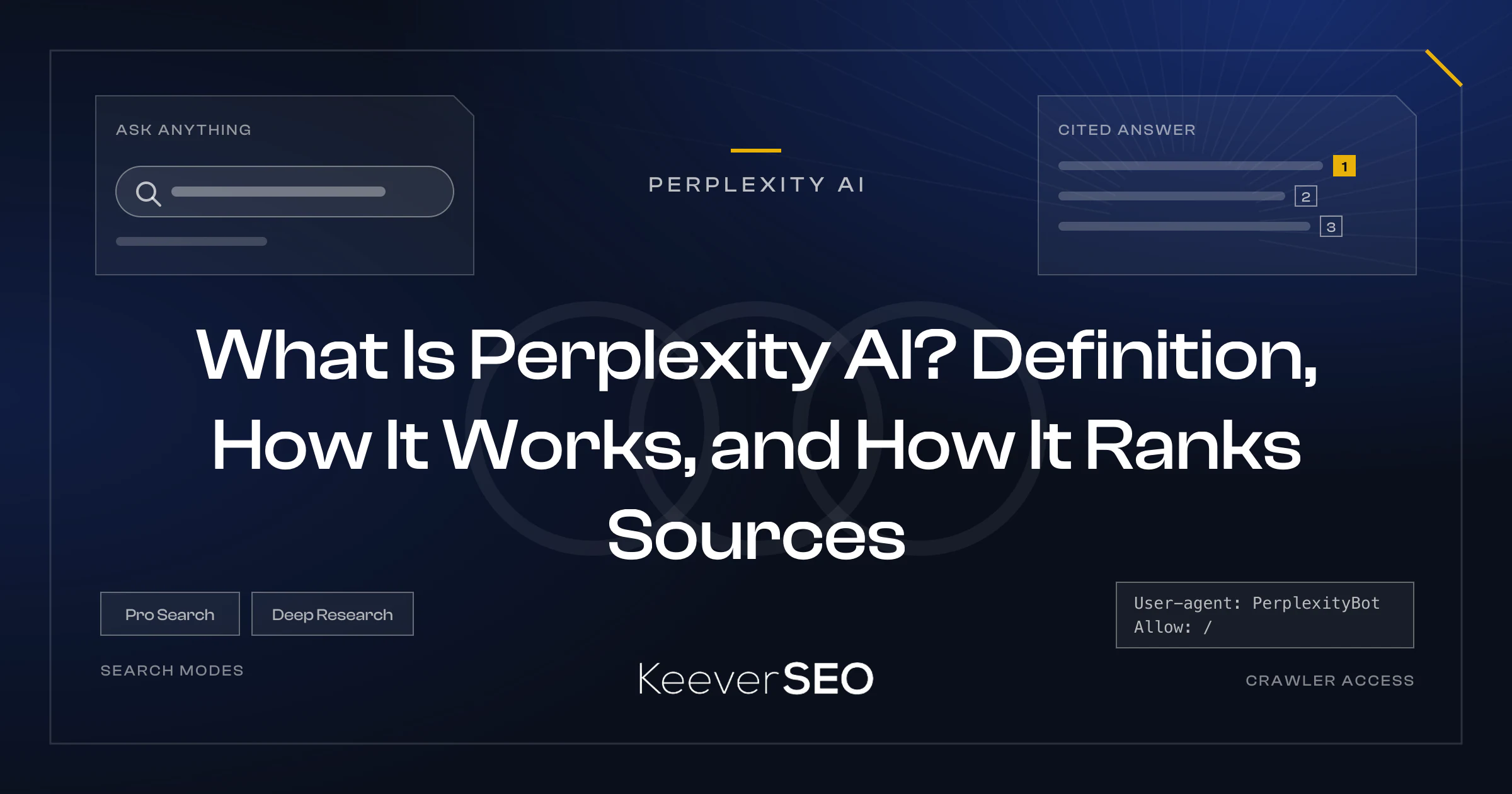
Perplexity AI is an AI-powered answer engine that searches the web in real time and returns a written answer with numbered citations to its sources. Perplexity answers questions, summarizes information, and lets users check each claim against the linked pages, and the company behind it was founded in 2022 by Aravind Srinivas, Denis Yarats, Johnny Ho, and Andy Konwinski.
Perplexity works by turning a question into searches, retrieving current pages, and handing the relevant passages to a language model that writes the cited answer, with sources chosen for relevance, authority, freshness, and how well a page supports the answer. Quick Search gives fast answers, Pro Search and Deep Research handle multi-step questions and long reports, and the Pro and Max plans add higher limits and more models.
People use Perplexity for research, quick facts, product comparisons, document summaries, news, and academic searches, which makes Perplexity important for search as an answer-first rival to lists of links, even though Google stays stronger for local and navigational searches. Local service businesses should care because Perplexity names providers and cites their pages, before the article turns to ranking and brand mentions in Perplexity, comparisons with other AI search engines, and accuracy. The first section defines Perplexity AI.
What Is Perplexity AI?
Perplexity AI is an AI-powered answer engine that searches the web in real time and returns written answers with numbered citations to its sources. The service combines web search with language models built by Perplexity and models from providers such as OpenAI and Anthropic, with the available models depending on the plan and search mode.
Perplexity AI writes conversational answers from current web information, and readers can confirm each point through the linked citations. The answer engine supports follow-up questions in the same thread, so users can move from a first answer into a full research session.
What Does Perplexity AI Do?
Perplexity AI answers questions by searching the web and combining information from several sources into one concise response with numbered citations. Users can open each citation to check the source and ask follow-up questions while Perplexity keeps the context of the thread.
The answer engine can produce structured research reports, summarize webpages and uploaded files, and answer shopping and finance questions. Perplexity's research tools review many sources and organize the findings into longer reports.
Who Created Perplexity AI?
Perplexity AI was created by Aravind Srinivas, Denis Yarats, Johnny Ho, and Andy Konwinski, who founded the company in 2022 and launched its answer engine in December of that year. In August 2022, Srinivas, now the CEO, and Yarats were already demoing their AI program to Meta AI chief Yann LeCun, with Andrew Konwinski and Johnny Ho as fellow cofounders, according to "Perplexity AI: Like Wikipedia and ChatGPT had a kid" by Rashi Shrivastava, Forbes, April 2024. Perplexity has its headquarters in San Francisco, California.
How Does Perplexity AI Work?
Perplexity AI works by reading a question, retrieving relevant web information, and using a language model to write a conversational answer. The answer combines information from the selected sources and attaches numbered citations so users can check the supporting material.
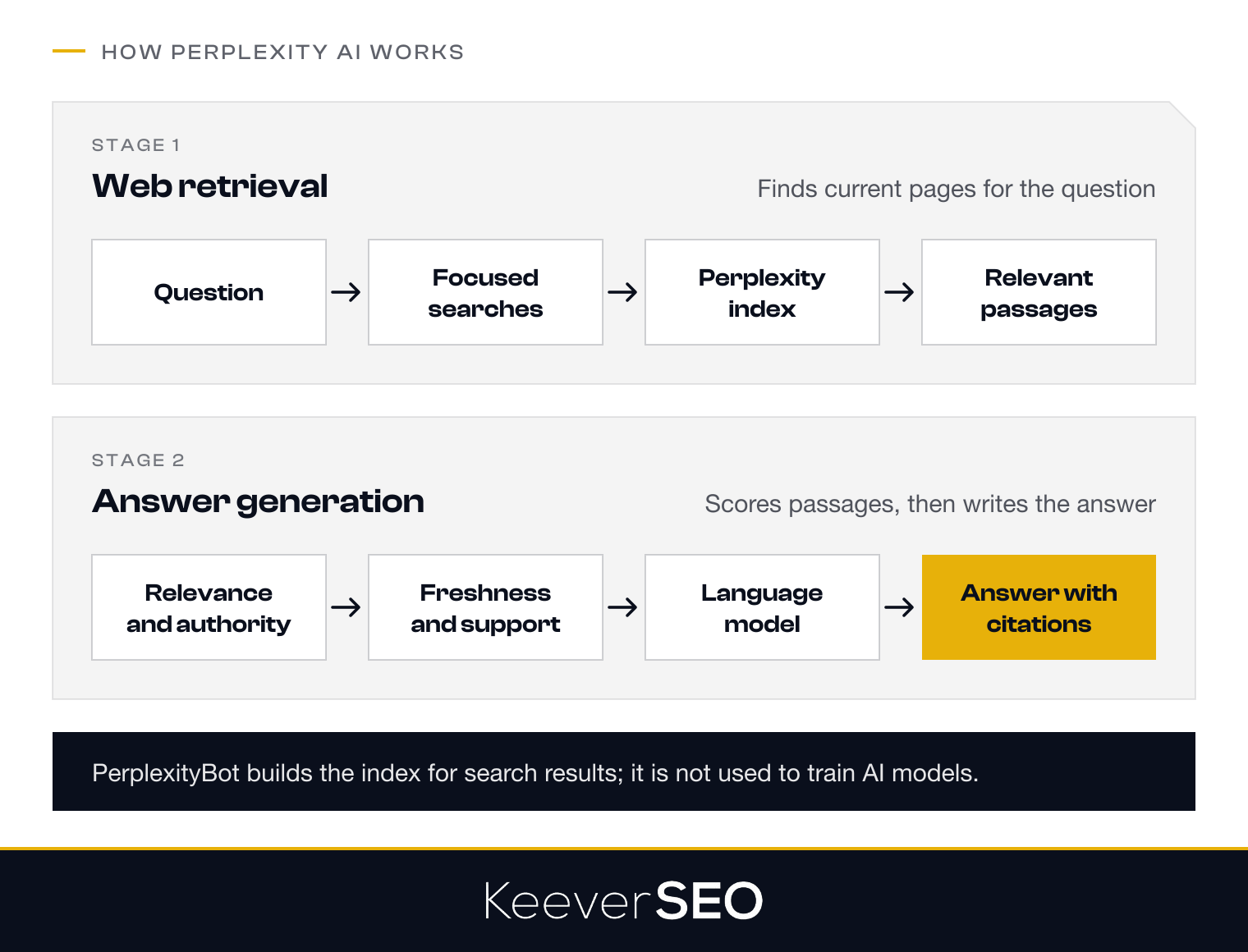
Perplexity's workflow has two stages: web retrieval and answer generation. Retrieval comes first, through a real-time web search that finds current pages for the question.
How Does Perplexity Search the Web in Real Time?
Perplexity searches the web in real time by rewriting a question into focused searches, then pulling current pages from its own index, which PerplexityBot builds by crawling sites that allow it. PerplexityBot exists "to surface and link websites in search results on Perplexity" and is not used to collect training data for AI foundation models, according to "Perplexity Crawlers" in Perplexity's documentation, accessed November 2026.
Perplexity then extracts the passages that answer the question and passes them to a language model. The model writes the answer and links numbered citations to the pages the passages came from.
How Does Perplexity Rank and Cite Sources?
Perplexity ranks and cites sources by scoring retrieved passages for relevance to the question, source authority, freshness, and how well each passage supports a claim, then linking numbered citations to the pages it uses. Perplexity has not published its ranking formula, so the clearest outside view comes from independent research: Metehan Yesilyurt's analysis of Perplexity's infrastructure describes a three-layer machine learning reranker, manual lists of authoritative domains, and early clicks shaping long-term visibility, according to "How Perplexity ranks content: Research uncovers core ranking factors and systems" by Danny Goodwin, Search Engine Land, August 2025, which notes the research is unverified.
Citation data shows which sources win: YouTube (16.1%) and Wikipedia (12.5%) are among the domains Perplexity mentions most across 78.6 million searches, according to "The 10 Most Mentioned Domains for ChatGPT, Perplexity, and AI Overviews Across 78.6M Searches" by Patrick Stox, Ahrefs, June 2025. Perplexity places the numbered citations beside or beneath each claim, and readers should open them, since a citation does not guarantee the page fully backs the claim.
What Are the Types of Perplexity AI Searches and Plans?
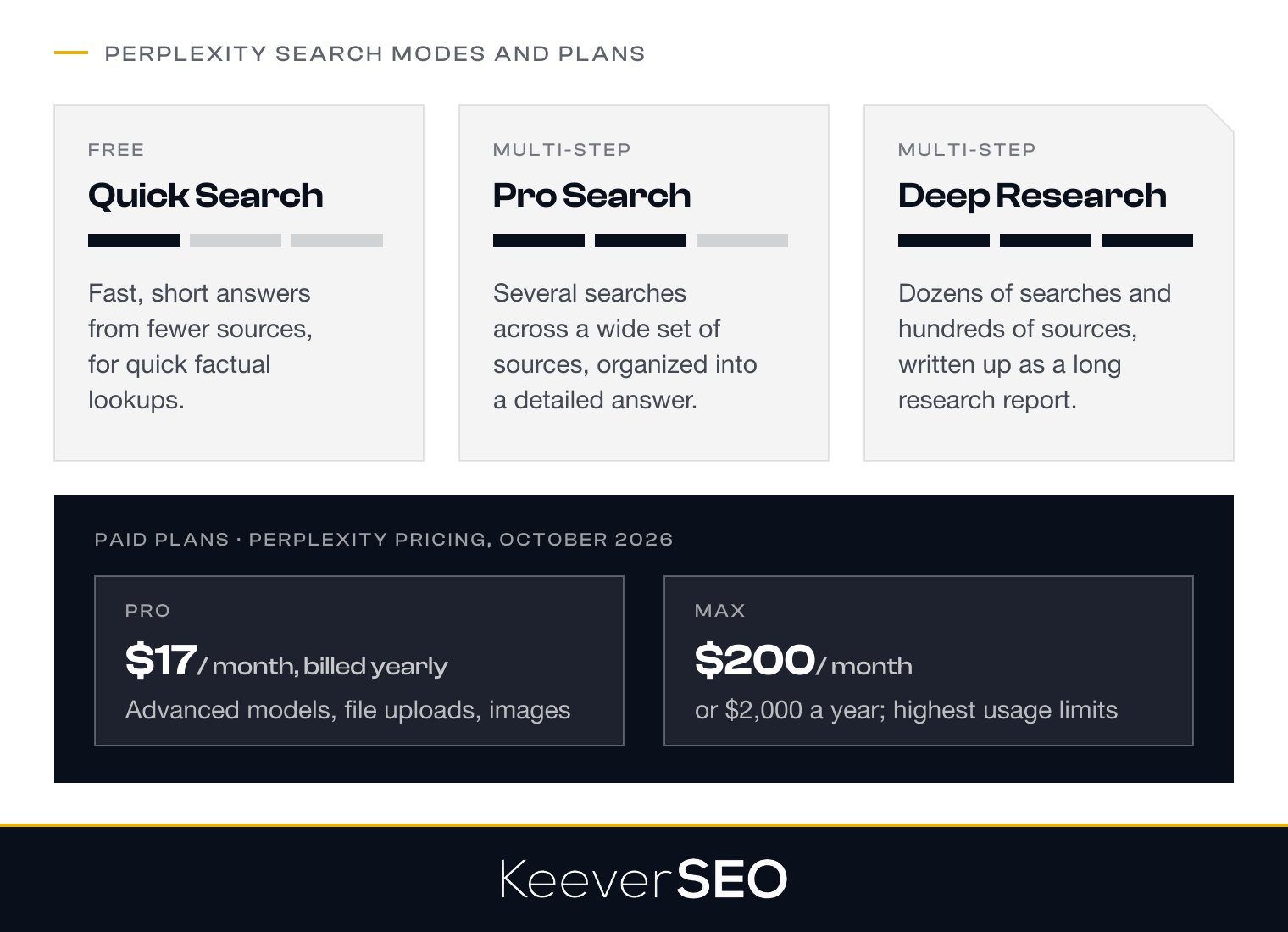
The types of Perplexity AI searches are Quick Search, Pro Search, and Deep Research, and the paid plans are Perplexity Pro and Perplexity Max. The free tier covers everyday searches, while the paid plans raise usage limits and add features, as the three sections below explain.
Quick Search
Quick Search is Perplexity's fast search mode for straightforward questions. Quick Search returns short answers from fewer sources than Pro Search, which suits quick factual lookups, and it is part of the free Perplexity experience.
Pro Search and Deep Research
Pro Search and Deep Research are Perplexity's multi-step modes: Pro Search runs several searches across a wide set of sources and organizes the findings into a detailed answer, while Deep Research runs dozens of searches and reviews hundreds of sources to produce a long research report. Users can pick an AI model or let Perplexity choose one for the task, and both modes cite their original sources, with the subscription plan setting access and usage limits.
Perplexity Pro and Max Plans
Perplexity Pro and Max are the paid plans: Pro costs $17 per month billed annually, and Max costs $200 per month or $2,000 per year, according to Perplexity's pricing page and its Help Center article "Perplexity Max", October 2026. Pro adds advanced AI models, extended Pro Search, file uploads, and image generation.
Max includes every Pro feature with the highest usage limits, wider access to models from OpenAI, Anthropic, and Google, and early access to new models. Limits on both plans vary by feature, and Max carries the largest allowances for research, searches, and file and app creation.
What Is Perplexity AI Used For?
The main uses of Perplexity AI are listed below:
- Research with sources: gathering current information and reviewing the linked citations.
- Quick factual answers: getting concise responses to direct questions.
- Product comparisons and shopping: comparing products, features, prices, and alternatives.
- Page and document summaries: summarizing webpages and uploaded files such as PDFs and spreadsheets.
- News tracking: following current events through briefings drawn from several sources.
- Academic searches: finding and combining academic papers and research.
Why Does Perplexity AI Matter for Search?
Perplexity AI matters for search because it gives users a written answer with sources instead of a list of links. Numbered citations tie each answer to its web sources, so users can confirm details and visit the cited pages.
Perplexity received 780 million queries in May 2025, CEO Aravind Srinivas said onstage at Bloomberg's Tech Summit, according to "Perplexity received 780 million queries last month, CEO says" by Aisha Malik, TechCrunch, June 2025. The answer-first model pushes Google and other search engines toward source-backed AI answers, while Perplexity's citations send referral traffic to the publishers and businesses it names.
What Are Perplexity AI's Key Features?
Perplexity AI's key features are listed below:
- Cited answers: numbered citations link each response to its sources.
- Follow-up threads: related questions keep the context of the conversation.
- Focus modes: searches can target areas such as academic research and writing.
- Spaces: conversations, files, and research stay organized by topic or project.
- File and image uploads: Perplexity analyzes documents, images, and other supported media.
- Comet browser: Perplexity's browser offers web assistance while users browse.
- Shopping answers: Perplexity compares products and supports purchase research.
- Finance answers: Perplexity explains finance questions with current web information.
- Perplexity Assistant: the assistant brings Perplexity search and task support to supported devices.
Is Perplexity AI Better Than Google?
No, Perplexity AI is not better than Google for every search, but it is stronger for complex research questions that need a written answer with numbered citations. Perplexity searches several sources and presents one cited response, which makes research and source-checking faster.
Google stays stronger for local, navigational, and shopping searches and covers a wider web index. Google Maps, business listings, product results, and direct links make Google the better tool for finding nearby providers, reaching known websites, and comparing prices.
Why Should Local Service Businesses Care About Perplexity AI?
Local service businesses should care about Perplexity AI because potential customers ask AI tools to recommend providers, and Perplexity answers by naming businesses and citing online sources. Questions about plumbers, dentists, lawyers, or restaurants can all end in a Perplexity shortlist.
A cited business gains visibility and qualified visits from people comparing local providers. Competitors take those recommendations instead when their websites or directory listings give clearer, more accessible information.
How Can a Business Get Cited by Perplexity AI?
To get cited by Perplexity AI, a business needs a website that PerplexityBot can reach, service pages that answer customer questions directly, and credible mentions on other sites. Robots.txt should allow PerplexityBot, and firewall rules should not block it.
Service pages should state accurate details about services, locations, qualifications, availability, and pricing factors under clear headings, with reliable sources and regular updates. Mentions on reputable review sites, local directories, community forums, and industry publications add outside evidence of credibility, although no tactic guarantees a citation.
How Does Keever SEO's AI Optimization Service Get Businesses Cited by Perplexity AI?
Keever SEO's AI optimization service gets businesses cited by Perplexity AI starting with a Perplexity visibility audit. The audit checks how frequently the business appears, which customer questions trigger citations, how competitors perform, and where content, technical, or authority gaps sit.
Keever SEO reviews crawler access, including robots.txt rules, meta robots directives, firewalls, and bot-management settings. The AI optimization service then rewrites service pages with direct answers, structured data, concise summaries, and supporting sources, builds mentions across reviews, directories, industry publications, and communities, and tracks citations, brand mentions, referral traffic, and share of voice.
How Do You Rank and Get Mentioned in Perplexity AI?
To rank and get mentioned in Perplexity AI, work on the signals both outcomes share: crawler access, relevance, clear passages, and trust. Answer-focused pages and credible third-party mentions help Perplexity find useful information and connect it with a brand, while PerplexityBot access makes the pages discoverable. The two questions below cover brand mentions and answers.
How Do You Get Your Brand Mentioned in Perplexity?
To get your brand mentioned in Perplexity, publish concise, well-cited content that answers customer questions and back it with accurate service pages, credible backlinks, and regular updates. Independent mentions on Reddit, review platforms, and industry websites give Perplexity trusted sources beyond the brand's own site, as long as community posts stay factual and useful.
How Do You Appear in Perplexity Answers?
To appear in Perplexity answers, find the questions users ask about your services, pricing, location, and alternatives, then write concise, self-contained passages that answer them with supporting sources. Testing those questions in Perplexity shows which pages it cites and where clarity, freshness, or evidence falls short.
How Does Perplexity AI Compare With Other AI Search Engines?
Perplexity AI compares with other AI search engines as the most research-focused option, attaching numbered citations to every answer. ChatGPT search adds cited web results to a wider assistant used for writing, coding, and analysis, Google AI Mode draws on Google's index for everyday, local, and shopping questions, and Microsoft Copilot uses Bing and connects with Microsoft products. Each engine can cite different pages for the same question, so Perplexity suits source-traceable research while the others fit wider search and productivity needs.
How Accurate Is Perplexity AI?
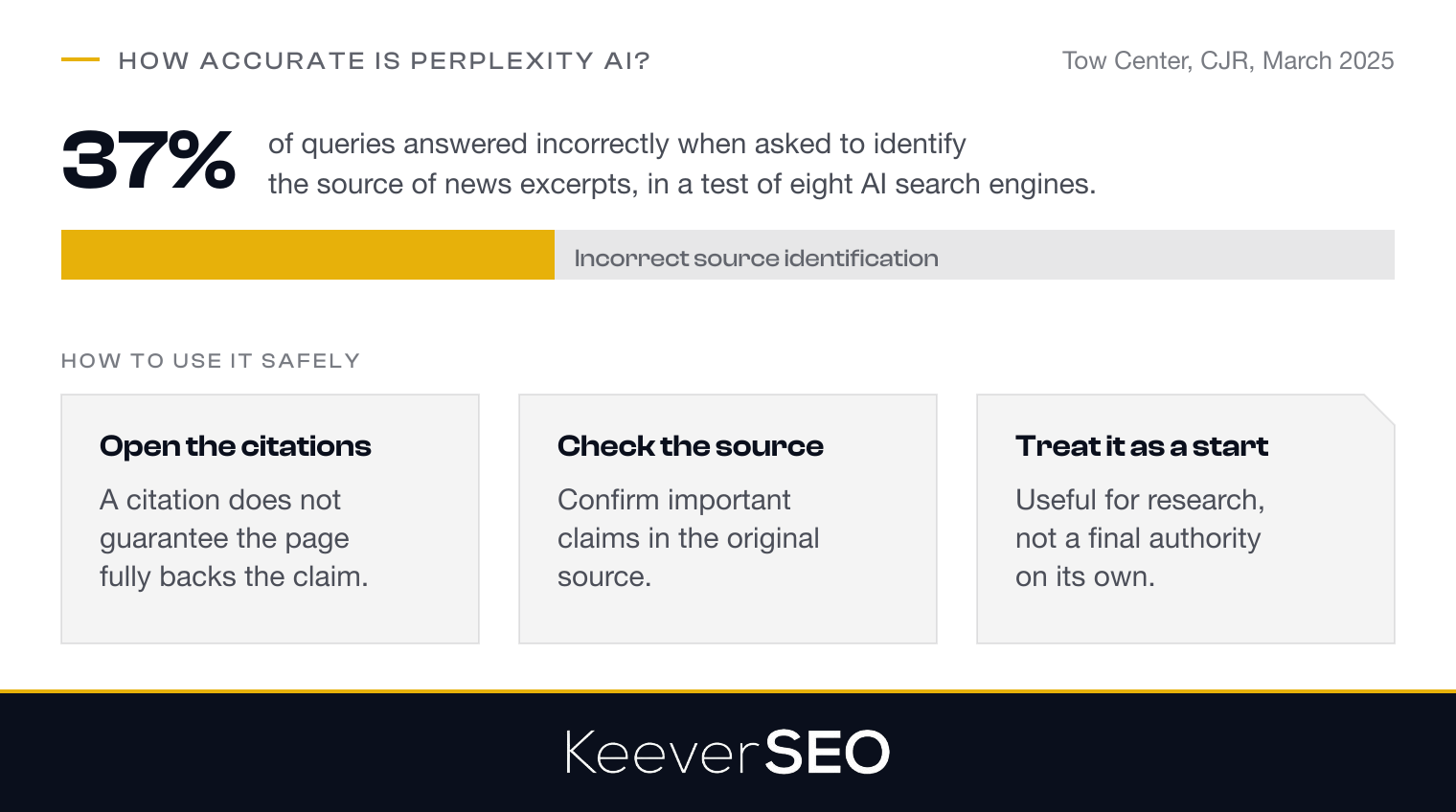
Perplexity AI is accurate enough to be a useful starting point, but its citations do not guarantee correct answers. In a test of eight AI search engines, Perplexity answered 37% of queries incorrectly when asked to identify the source of news excerpts, according to "AI Search Has a Citation Problem" by Klaudia Jaźwińska and Aisvarya Chandrasekar, Columbia Journalism Review's Tow Center for Digital Journalism, March 2025, so important claims need checking in the original sources.
What Does Perplexity AI Mean for the Future of Search?
Perplexity AI points toward a search experience where cited, written answers become the default instead of a list of links. Perplexity's browsing tools already search live information, open pages, and carry out multi-step tasks for users.
Agentic browsing moves the value of search from clicks alone toward citations, referrals, and tasks completed with AI help. Through that shift, Perplexity AI stays what it was built to be: an AI-powered answer engine that searches the web in real time and returns written answers with numbered citations to its sources.