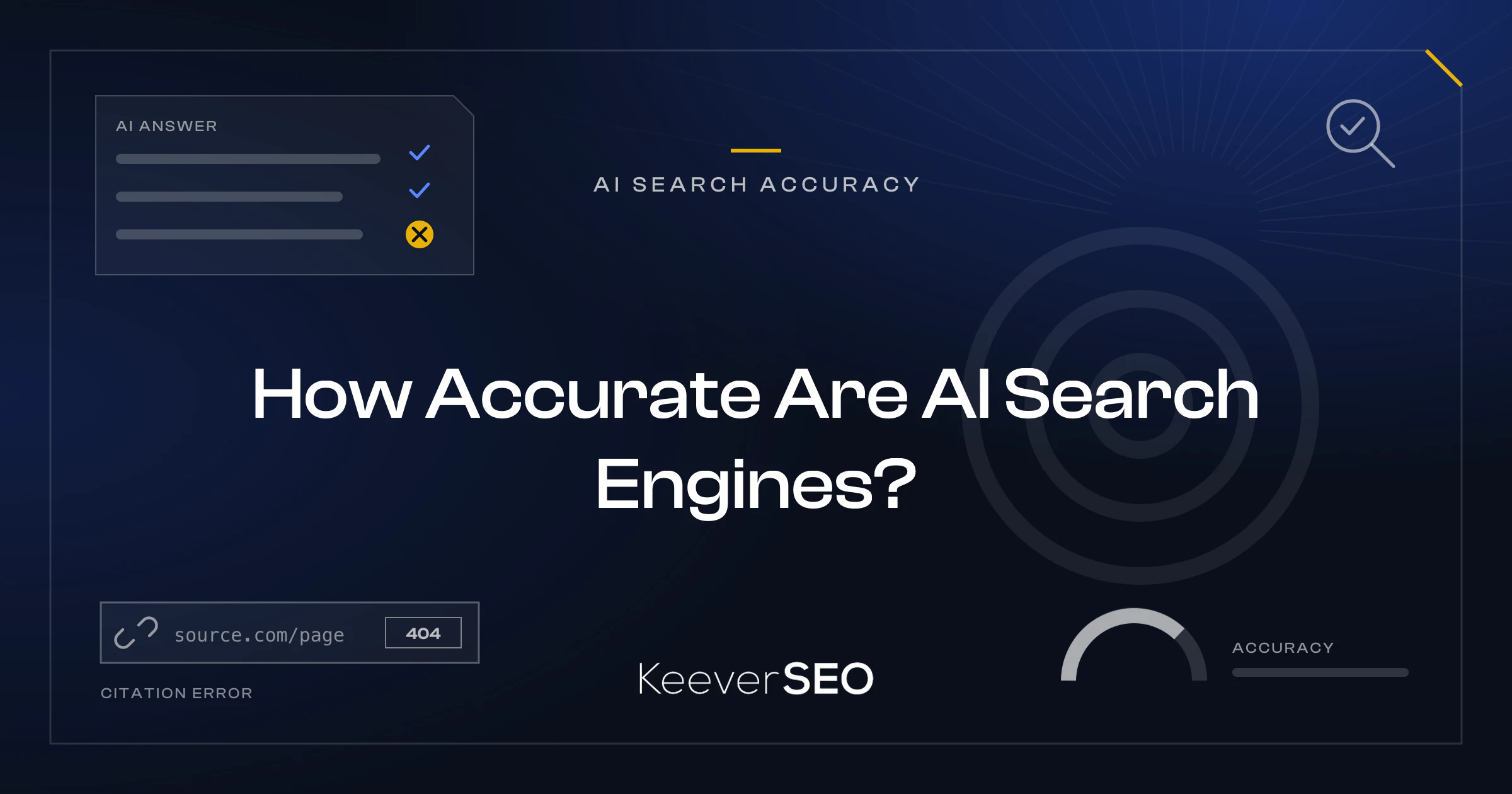
AI search engines have no single accuracy rate, because results depend on the query and on what a study measures. A Columbia Journalism Review test found that eight tools "provided incorrect answers to more than 60 percent of queries" across 1,600 news-article searches, which measures source identification rather than general factual accuracy, according to "AI Search Has a Citation Problem" by Klaudia Jaźwińska and Aisvarya Chandrasekar, March 2025.
A separate New York Times analysis with the startup Oumi found that Google AI Overviews answered a factual benchmark accurately 91% of the time with Gemini 3, up from 85% with Gemini 2. The different results show why accuracy claims need to name the system, benchmark, and task tested.
How Accurate Are AI Search Engines?
AI search engines are accurate enough to produce useful answers, but independent tests show frequent citation and sourcing errors. The Tow Center for Digital Journalism found incorrect source information in more than 60% of 1,600 tested queries, in a test of attribution rather than every factual claim. The EBU and BBC report "News Integrity in AI Assistants" (October 2025) found that "45% of all AI answers had at least one significant issue" across 22 public service media organizations.
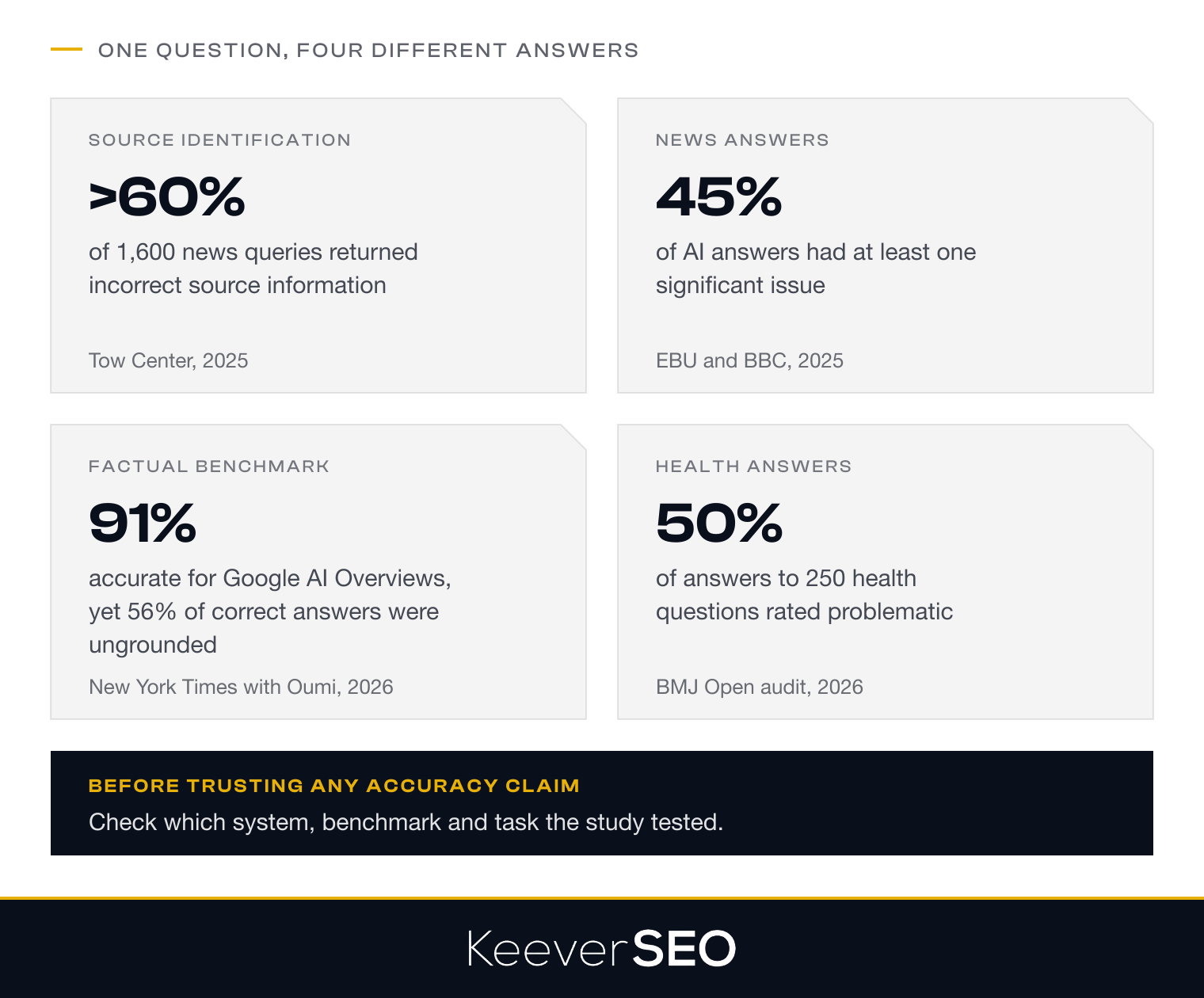
The New York Times analysis with Oumi, reported in "How accurate are Google's AI overviews?" in April 2026, found 91% accuracy in February 2026, up from 85% in October 2025. The same analysis found that 56% of correct answers were ungrounded, up from 37%, which shows that factual accuracy and source grounding are different measures. Google disputed the study, saying it "has serious holes."
What Did Research Find About AI Search Engine Accuracy?
Research on AI search engine accuracy found that eight tools gave incorrect results in more than 60% of 1,600 citation-retrieval tests run by Columbia University's Tow Center for Digital Journalism. The researchers asked each engine to identify news articles by headline, publisher, publication date, and URL, which tested source accuracy rather than general answer accuracy.
Perplexity recorded the lowest error rate at 37%, while Grok 3 recorded the highest at 94%. The results show that AI search engines can misidentify sources even when their answers sound fluent.
How Often Do AI Search Engines Cite the Wrong Source?
AI search engines cited the wrong source or made a related citation error in more than 60% of the Tow Center's tested queries. The 2025 study covered eight AI search tools across 1,600 queries, checking article headlines, publishers, dates, and URLs. Broken or fabricated links added to the problem, since "out of the 200 prompts we tested for Grok 3, 154 citations led to error pages." A wider measure from Ahrefs, "New Study: How Often Do AI Assistants Hallucinate Links? (16 Million URLs Studied)," found that "AI assistants send visitors to 404 pages 2.87x more often than Google Search."
Which AI Search Engines Scored Most and Least Accurate?
The AI search engines that scored most and least accurate in the Columbia Journalism Review's Tow Center citation test were Perplexity and Grok 3. The test of 200 queries per engine measured whether engines identified news articles from excerpts, not general accuracy across all search questions. The scores are listed below:
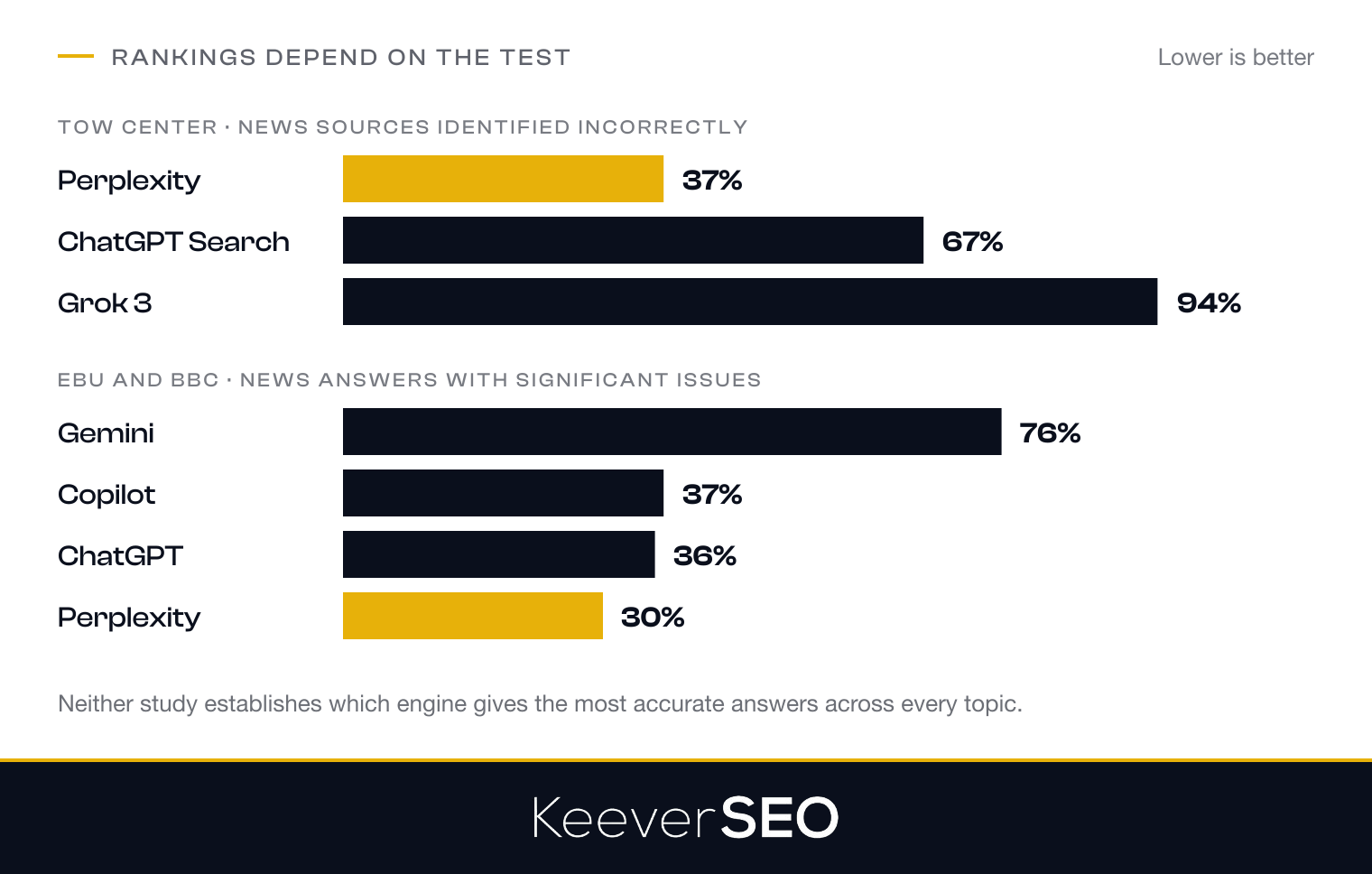
- Perplexity: Answered 37% of queries incorrectly.
- ChatGPT Search: Misidentified 134 of 200 articles, or 67%.
- Grok 3: Answered 94% of queries incorrectly, and 154 of 200 citations led to error pages.
The EBU and BBC study ranked assistants differently on news questions: Gemini showed "significant issues in 76% of responses," followed by Copilot at 37%, ChatGPT at 36%, and Perplexity at 30%. Neither study establishes which engine gives the most accurate answers across every topic.
Why Do AI Search Engines Give Wrong Answers?
AI search engines give wrong answers because language models generate unsupported details or retrieval systems select weak, outdated, or irrelevant sources. A system can misread a webpage's context, combine claims from separate pages, or attach an answer to a citation that does not support it.
Confident wording can make an uncertain or incorrect answer sound verified. Those fluent but unsupported claims are called AI hallucinations.
What Are AI Hallucinations?
AI hallucinations are fluent, plausible-sounding statements that are false, misleading, or unsupported by reliable evidence. The National Institute of Standards and Technology calls the problem confabulation, "the production of confidently stated but erroneous or false content," in "Artificial Intelligence Risk Management Framework: Generative Artificial Intelligence Profile" (NIST AI 600-1).
AI hallucinations can include invented citations, links, studies, or other sources. A cited source may not exist or may fail to support the claim it accompanies.
How Does Retrieval-Augmented Generation Reduce Errors?
Retrieval-augmented generation (RAG) reduces errors by retrieving relevant documents and grounding answers in their content. The language model uses external evidence alongside its trained parameters, and citations help users check the evidence. Lewis and colleagues' 2020 paper "Retrieval-Augmented Generation for Knowledge-Intensive NLP Tasks" found that RAG models "generate more specific, diverse and factual language" than a baseline without retrieval.
RAG does not guarantee accurate answers. A retrieval system can return outdated, irrelevant, incomplete, or contradictory sources, and a language model can misread retrieved passages. Stanford's 2024 study "Hallucination-Free? Assessing the Reliability of Leading AI Legal Research Tools" found that RAG-based legal tools reduced errors compared with GPT-4 but still produced incorrect information more than 17% of the time.
What Is the Most Accurate AI Search Engine?
The most accurate AI search engine in the Tow Center's independent comparison of eight tools was Perplexity, but no engine ranks first for every query type. Perplexity answered 37% of tested news queries incorrectly, while Grok 3 had a 94% error rate, and those results measure source identification for news excerpts, not general factual accuracy. AI search accuracy varies by topic, query, and whether a test evaluates answers or citations.
Is Google or AI Search More Accurate?
Google Search is easier to verify, while AI search provides more convenient synthesized answers, and no study settles which is more accurate in every case. Google presents ranked links that users can open and assess, and AI search combines information into a single response. The Tow Center chose excerpts that, "if pasted into a traditional Google search, returned the original source within the first three results," yet the eight AI tools got most of them wrong. AI answers can therefore blend accurate and incorrect details into one confident-sounding reply.
Can You Trust AI Search Engines for Health, Legal, and Financial Questions?
No, you cannot trust AI search engines alone for health, legal, and financial questions, because they can provide inaccurate, incomplete, or fabricated answers. A BMJ Open audit of five chatbots, reported by BMJ Group in May 2026, rated 50% of responses to 250 health questions as problematic, with 20% highly problematic. Stanford's "Hallucinating Law" (January 2024) found hallucination rates of 69% to 88% for legal queries on 2023-era models without retrieval.
Check important claims against primary sources, such as government guidance, medical institutions, court records, and financial regulators. Consult a qualified doctor, lawyer, or financial professional before making consequential decisions.
Are AI Search Engines Biased?
Yes, AI search engines can be biased through the sources they select and patterns in their training data. An unbalanced set of citations can favor certain viewpoints, regions, or commercial sources, and "News Source Citing Patterns in AI Search Systems" by Kai-Cheng Yang (arXiv preprint, July 2025) found that news citations "concentrate heavily among a small number of outlets and display a pronounced liberal bias." Language models can reproduce biases in their data and design, as reviewed in "Bias and Fairness in Large Language Models: A Survey." Compare answers from multiple engines and check whether their sources represent different institutions, regions, and viewpoints.
How Can You Verify an AI Search Engine Answer?
You can verify an AI search engine answer by checking its citations, publication details, and primary evidence. The verification steps are listed below:
- Open each cited source and confirm that it supports the answer's exact claim.
- Check the source's author, publisher, and publication or update date.
- Confirm important claims against a primary source, such as an official record or original study.
- Compare the answer with results from a second AI search engine and investigate differences.
Are AI Search Engines Getting More Accurate Over Time?
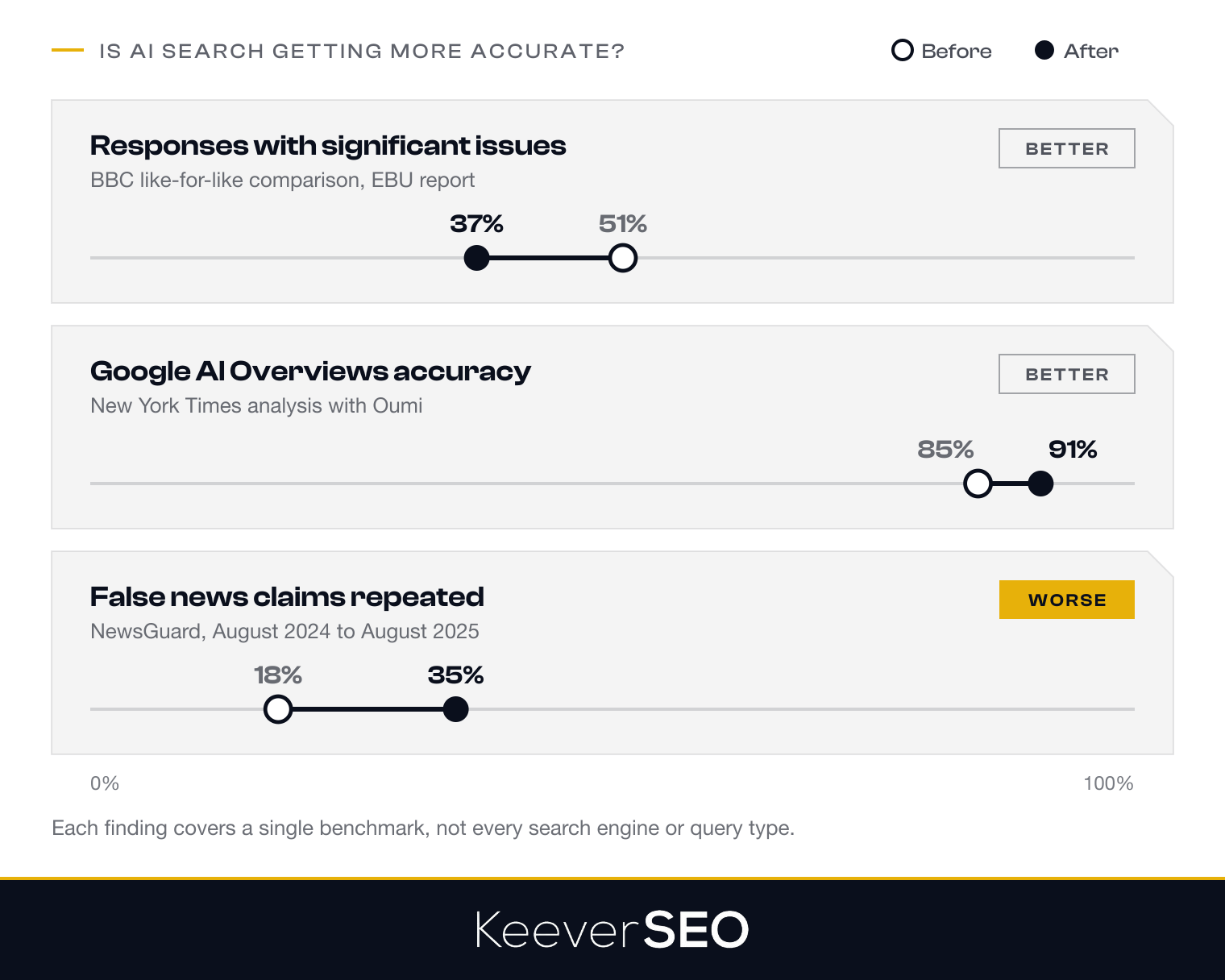
Yes, AI search engines are getting more accurate in some repeated benchmarks, but errors and sourcing problems remain. The BBC's like-for-like comparison in the EBU report showed that "the share of responses with significant issues of any type improved from 51% to 37%," and the New York Times analysis with Oumi found that Google AI Overviews rose from 85% to 91% accuracy. NewsGuard points the other way: its "August 2025 AI False Claim Monitor" found that leading AI tools repeated false news claims 35% of the time, up from 18% in August 2024, as refusal rates fell to zero. The findings cover single benchmarks, not every search engine or query type.
What Does AI Search Inaccuracy Mean for Businesses?
AI search inaccuracy means customers can see incorrect business hours, prices, services, or reviews. AI engines may combine outdated website content, inconsistent business listings, and third-party pages into a misleading description.
Wrong details can cause missed visits, lost sales, and reputational damage. Businesses reduce those risks by correcting their information across websites, listings, and authoritative third-party sources.
How Can a Business Correct What AI Search Engines Say About It?
A business can correct what AI search engines say about it by publishing consistent, current facts across its website and business listings. Keep the business name, address, phone number, hours, services, prices, and contact details aligned, and update profiles such as Google Business Profile.
Add accurate Organization structured data that matches visible website content. Reputable directories, professional associations, and local news coverage reinforce the same facts across authoritative third-party sources.
How Does Keever SEO's AI Optimization Service Help AI Search Engines Describe Businesses Accurately?
Keever SEO's AI optimization service helps AI search engines describe businesses accurately by giving them consistent business information to find. The AI accuracy SEO agency service audits how a business, its services, locations, and credentials appear across platforms such as ChatGPT, Perplexity, Gemini, and Google AI Overviews.
Keever SEO aligns website content, business listings, and third-party mentions, then adds relevant schema markup to clarify main facts. Ongoing answer monitoring tracks AI mentions, citations, and inaccuracies, which helps businesses identify outdated or conflicting information.
How Does Accuracy Differ Across AI Search Engines?
Accuracy differs across AI search engines because systems select different sources and connect citations to claims with varying precision. Google AI Overviews scored 91% on the benchmark in the New York Times analysis with Oumi, but 56% of correct answers were ungrounded. Perplexity presents visible citations that help users check its answers, but the Tow Center test found 37% of its responses incorrect. Citation visibility makes verification easier, but it does not guarantee that an AI search answer accurately reflects its sources.
How Accurate Are Google AI Overviews?
Google AI Overviews are 91% accurate on the Oumi benchmark reported by the New York Times, which leaves about 9% of responses incorrect, and Google disputed the study's methodology. The benchmark, SimpleQA, is built from questions that are hard for models, so the score does not measure ordinary searches.
Google said in 2024 that AI Overviews accuracy "is on par with another popular feature in Search," in "AI Overviews: About last week" by Elizabeth Reid, while each AI Overview carries the note "AI can make mistakes, so double-check responses."
How Reliable Are Perplexity's Cited Answers?
Perplexity's cited answers are more reliable than most rivals' in citation tests, but they still need checking. Citations help readers confirm whether a source exists, remains current, and supports the answer. The Tow Center study found that Perplexity answered 37% of tested news queries incorrectly, despite ranking first among eight AI search engines.
How Do AI Search Engines Differ From Traditional Search Engines Beyond Accuracy?
AI search engines differ from traditional search engines beyond accuracy by generating a conversational answer instead of displaying ranked webpages. A synthesized response can answer a question quickly without requiring users to open several links. Traditional search results show source pages directly, leaving users to compare information and assess credibility. AI-generated summaries can reduce clicks to websites when users find the answer within the search result.
Which Sources Do AI Overviews Rely On?
The sources AI Overviews rely on include Google properties, YouTube, Reddit, Facebook, and other reference or community sites. Peec AI's "Top domains cited by AI search: Analysis based on 30M sources" (March 2026) ranks YouTube, Reddit, Facebook, LinkedIn, and Medium as the top five domains in US AI Overviews, and the Oumi analysis of 5,380 cited sources found that Facebook and Reddit were the second- and fourth-most-cited. Source types vary by query, so treat any single ranking as a snapshot.
Should You Rely on AI Search Engines for Accurate Answers?
No, you should not rely on AI search engines alone for accurate answers, although they are useful for quick orientation. The 91% benchmark score for Google AI Overviews shows that even high-performing AI search makes errors.
Open the cited pages and confirm that the sources support the answer and remain current. AI search engines provide helpful starting points, but their accuracy does not make them reliable final authorities.