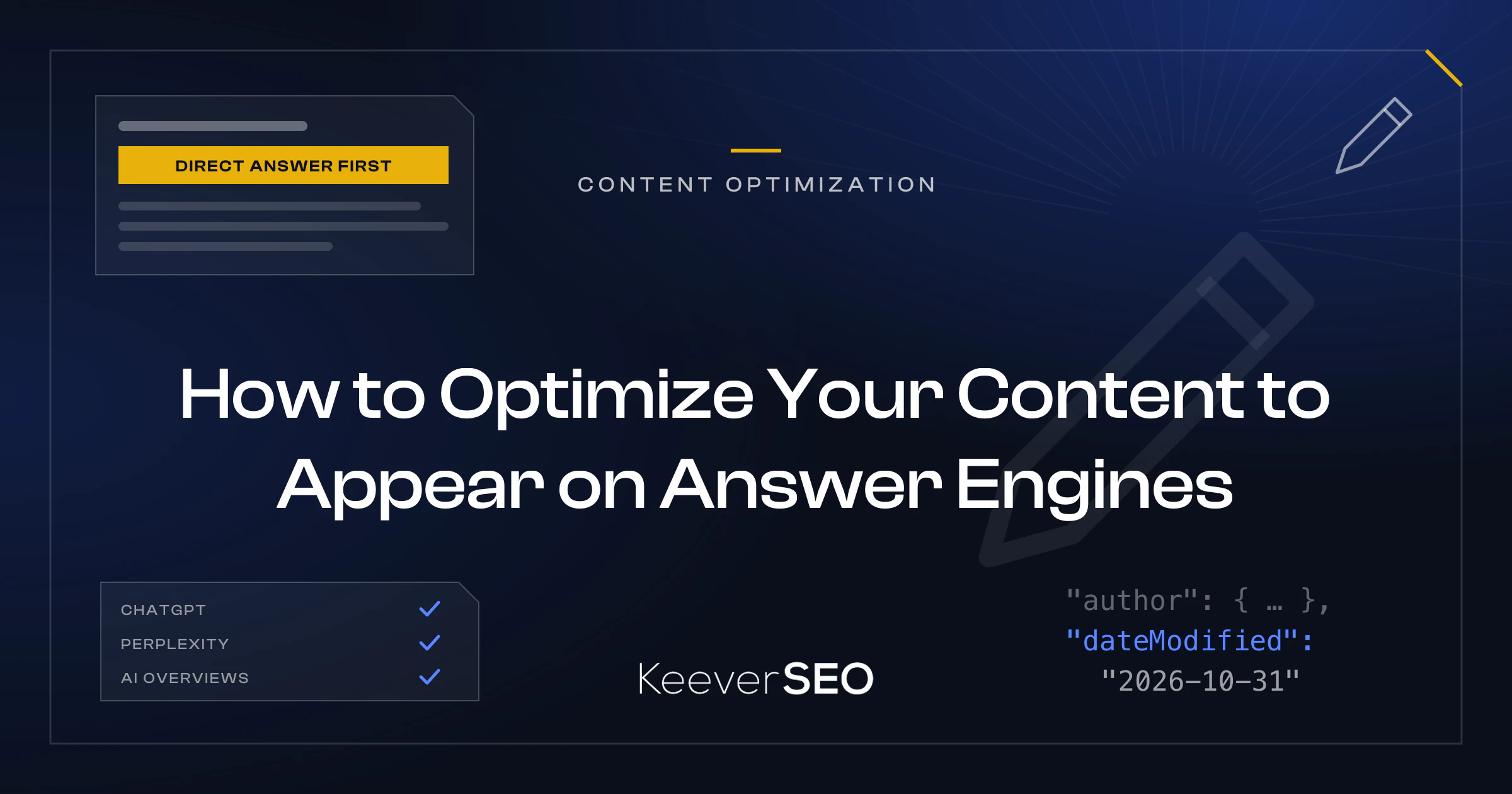
To optimize your content to appear on answer engines, answer each question directly in self-contained passages, add facts and schema, prove your credentials, and earn mentions beyond your site. Appearing means having a passage extracted as an answer, a page cited as a linked source, or a brand mentioned in Google AI Overviews, ChatGPT, Perplexity, and similar tools. Before optimization, confirm that important pages are indexable and indexed in Google and Bing, list target questions, and record your current AI citations.
Follow nine steps: check existing citations, map questions to pages, rewrite page openers as direct answers, divide long sections into standalone passages, add sourced facts, apply accurate schema, display author credentials and update dates, distribute consistent answers through trusted channels, and monitor citations. Answer engines extract definitions, numbered steps, comparison tables, concise FAQs, and statistics with sources, and clear facts and consistent information across sources can reduce inaccurate AI descriptions. Avoid burying answers, blocking crawlers, relying on JavaScript-only content, using vague promotional copy, omitting dates, or publishing unsupported claims.
Results vary by answer engine, crawl frequency, and page authority, so treat optimization as ongoing work rather than a guaranteed timeline. Local service businesses should prioritize service pages, location pages, and FAQs about pricing and process, and an agency can help with large sites, technical schema, thin writing resources, or ongoing monitoring. The sections below explain engine-level tactics, broader AEO techniques, and schema, beginning with what appearing on answer engines means.
What Does It Mean for Content to Appear on Answer Engines?
Content appears on answer engines when an AI system uses information from a webpage to answer a user's question. The system may extract a passage as a direct answer, cite the webpage as a linked source, or mention the brand in a generated response.
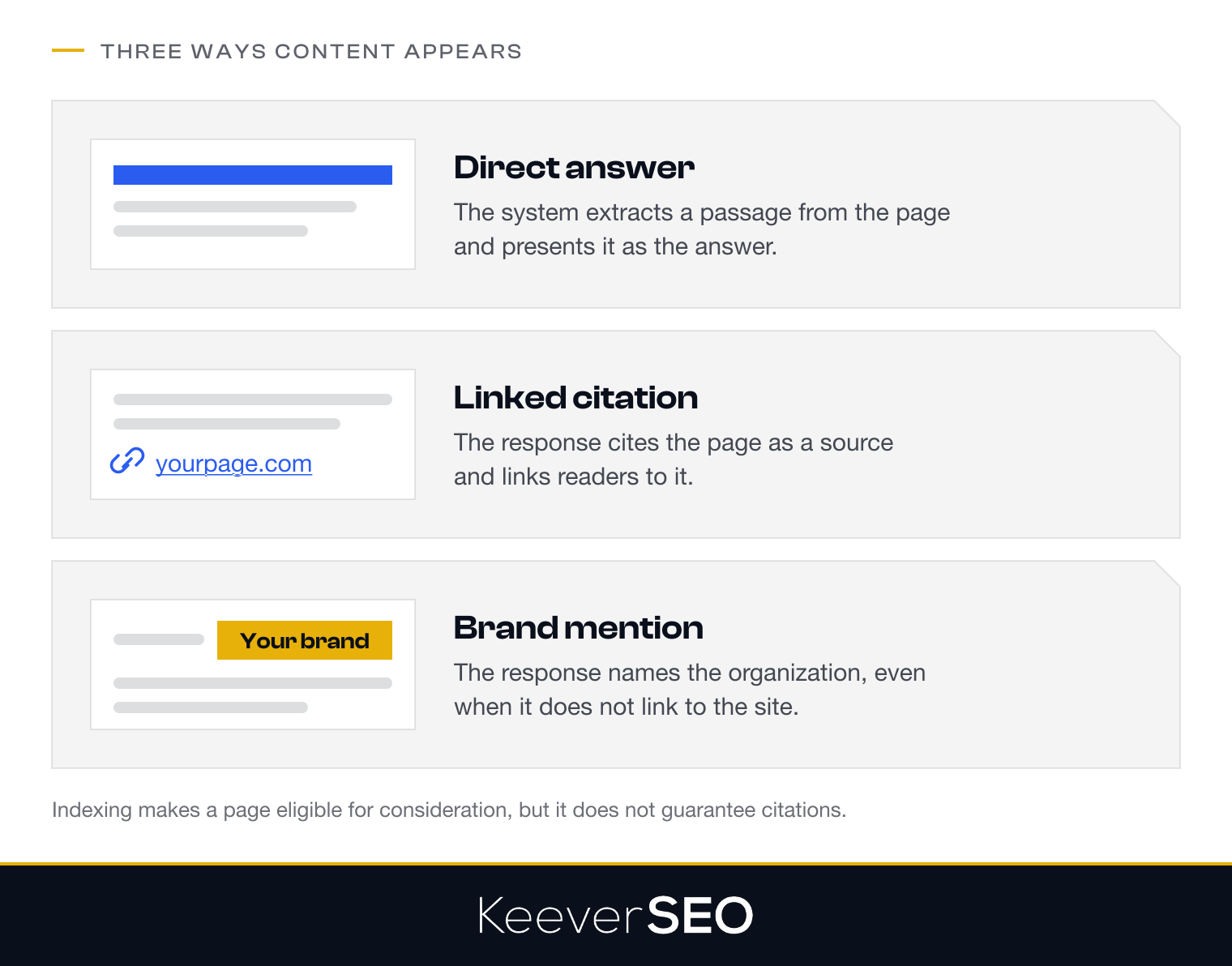
A direct answer presents relevant information from a page, while a citation links readers to the source webpage. A brand mention names an organization in the response, even when the answer engine does not link to its site.
What Do You Need Before Optimizing Content for Answer Engines?
Before optimizing content for answer engines, you need crawlable pages, search indexing, target questions, and a baseline of current citations. The prerequisites for optimizing content are listed below:
- Confirm page indexability: Check that priority pages return successful status codes, use canonical URLs, allow crawling, and avoid noindex directives.
- Check Google and Bing indexing: Verify that search engines index priority URLs, submit an XML sitemap, and resolve crawl or indexing errors. Indexing makes pages eligible for consideration but does not guarantee citations.
- Build a target-question list: Gather customer questions from search suggestions, People Also Ask, support requests, sales conversations, and service inquiries.
- Record current AI citations: Ask target questions in answer engines and log brand mentions, cited URLs, and competitor references.
How Do You Optimize Content to Appear on Answer Engines?
To optimize content to appear on answer engines, follow nine steps that make pages easier to interpret, extract, and cite. Check existing citations, map target questions, rewrite page openers with direct answers, and divide long sections into self-contained passages.
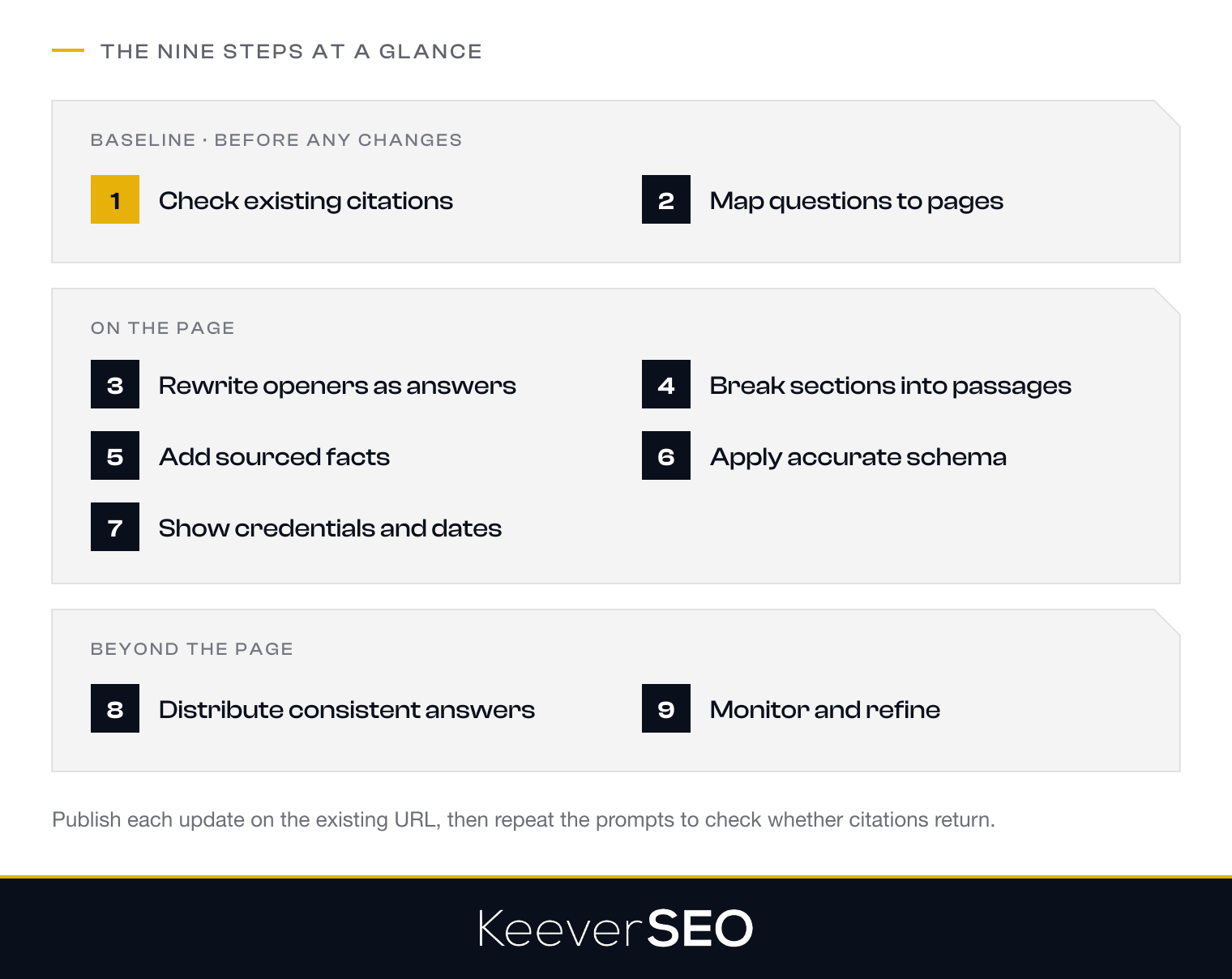
Then add verifiable facts and accurate schema, show author credentials and update dates, distribute consistent information beyond your website, and monitor citation changes. Begin by checking which answer engines already cite your content.
1. Check Which Answer Engines Already Cite Your Content
Checking which answer engines already cite your content comes before any changes. Ask ChatGPT with web search enabled, Perplexity, and Google Search the same target questions your customers ask. Record each cited page, the passage used, competing sources, the check date, and any brand mention without a link. Verify every citation against the original page, because answer-engine source panels can be incomplete or inaccurate.
A citation baseline shows which questions already lead answer engines to your website and where citation gaps remain. Use those gaps to identify the main question and related sub-questions each page needs to answer.
2. Identify the Questions Behind Each Page
Identifying the questions behind each page means mapping every page to one primary question and the related sub-questions customers ask. The primary question should match the page's purpose and search intent, while supporting questions can cover definitions, costs, comparisons, processes, use cases, and concerns.
Find question ideas in Google's People Also Ask results, Search Console queries, customer-service conversations, sales calls, reviews, and forums. Assign each question to the most relevant page or section to prevent competing pages and reveal unanswered topics, then use the mapped questions to guide the page opener rewrite.
3. Rewrite Page Openers as Direct Answers
Rewriting page openers as direct answers means the first sentence answers the page's main question. Follow the answer with a short supporting paragraph that adds main context, qualifications, or next steps.
For a page about roof repair costs, write an opener such as "Roof repair costs between $300 and $1,500, depending on the damage, materials, and roof size," using your own verified prices. Then explain the main cost factors and when a professional inspection can help.
4. Break Long Sections Into Self-Contained Passages
Breaking long sections into self-contained passages means dividing content into focused passages that each answer one question completely. Use question-based headings, such as "How long does a roof replacement take?" instead of vague headings like "Our Process," and place the direct answer immediately below each heading.
Keep each passage focused on one idea and clear when read alone. Name the subject directly, include necessary context, and avoid references that depend on information elsewhere on the page. Microsoft Bing's "Optimizing Your Content for Inclusion in AI Search Answers" (October 2025) explains that assistants "break content down, a process called parsing, into smaller, structured pieces," while Google states that "there's no requirement to break your content into tiny pieces for AI to better understand it," so write passages for readers first.
5. Add Facts, Statistics, and Named Sources
Facts, statistics, and named sources make answer-engine content easier to assess and cite. Place each source beside the claim it supports, and include the publication date, measurement period, and relevant context for every figure.
A 2024 KDD paper by Aggarwal and colleagues, "GEO: Generative Engine Optimization," found that the Cite Sources, Quotation Addition, and Statistics Addition methods "achieved a relative improvement of 30-40%" in visibility within generative engine responses. Use current, authoritative evidence, such as government data, peer-reviewed research, or official reports, to strengthen important passages without overstating what the source establishes.
6. Mark Up the Page With Schema
Marking up the page with schema helps answer engines interpret a page's content, entities, and relationships. Add accurate JSON-LD using Article or BlogPosting for editorial content, FAQPage for visible question-and-answer sections, HowTo for visible instructions, and Organization for business identity. Google stopped showing FAQ rich results on May 7, 2026, and How-to rich results in September 2023, so treat both as machine-readable labels, not rich-result opportunities.
Place JSON-LD in a <script type="application/ld+json"> block, and make sure every marked-up detail matches visible page content. Validate the markup with Google's Rich Results Test and the Schema Markup Validator, then use URL Inspection in Google Search Console to check whether Google can access the deployed page. Valid schema improves machine interpretation but does not guarantee a rich result or an AI citation.
7. Show Author Expertise and Visible Update Dates
Showing author credentials helps readers and answer engines assess who created a page and why the author can address its topic. Add a byline linking to a bio that describes relevant credentials, professional experience, training, or first-hand work, such as client projects, product testing, or field research.
A visible "Last updated" date shows when the page received a meaningful review or revision. Keep the displayed date consistent with the page's dateModified structured data, and change the date only after substantive updates.
8. Distribute the Content Beyond Your Website
Distributing the content beyond your website means publishing consistent, accurate answers across trusted sources. Maintain matching business details, service descriptions, credentials, and main facts across business profiles, industry publications, relevant forums, review platforms, and social posts.
Contribute useful answers to industry discussions, share original findings with publications, and keep business profiles complete. Independent mentions give answer engines additional sources for verifying your brand, while repeated promotional posts can weaken credibility.
9. Monitor Citations and Refine the Page
Monitoring citations and refining the page shows whether content optimization increases visibility. Re-run the same target-question prompts in ChatGPT, Perplexity, and Google AI Overviews at consistent intervals, recording brand mentions, linked citations, cited URLs, competitor sources, and changes between runs.
Refresh pages that lose citations by correcting outdated facts, answering newly surfaced questions, strengthening evidence, and improving direct-answer passages. Publish each update on the existing URL, then repeat the prompts to check whether citations return.
Which Content Formats Do Answer Engines Extract Most Often?
The content formats answer engines extract most often are listicles, articles, and product pages. "Listicles led at 21.9% of citations, followed by articles (16.7%) and product pages (13.7%)," according to "AI citations favor listicles, articles, product pages: Study" by Danny Goodwin, published by Search Engine Land in March 2026 on Wix Studio research covering 75,000 AI answers. The passage-level formats that make answers easy to extract are listed below:
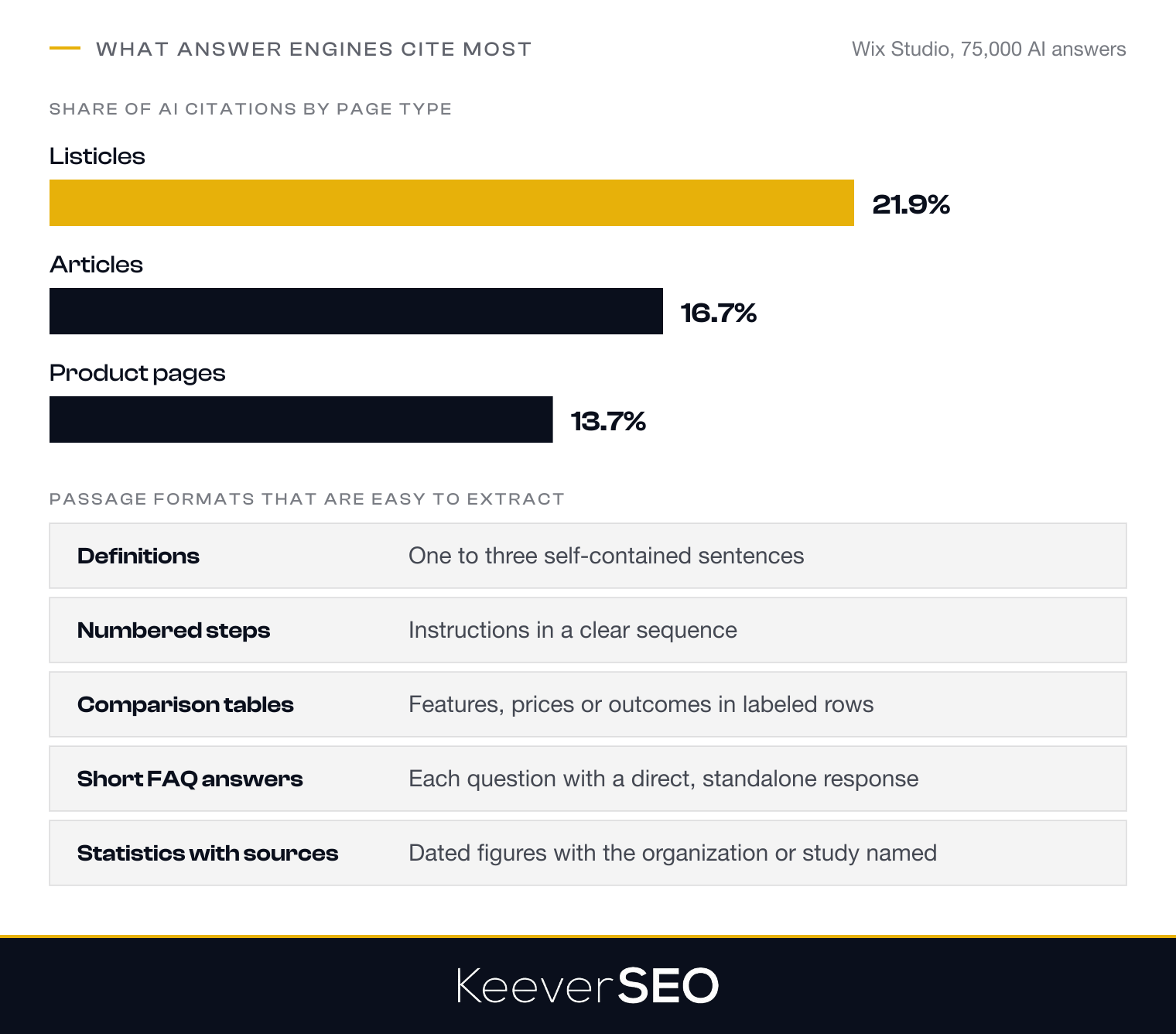
- Definitions: Explain a term in one to three self-contained sentences.
- Numbered steps: Present instructions in a clear sequence.
- Comparison tables: Organize comparable features, prices, or outcomes in labeled rows.
- Short FAQ answers: Pair each question with a direct, standalone response.
- Statistics with sources: State dated figures and name the organization or study behind them.
Formatting supports extraction, but accurate, relevant, well-sourced information remains necessary for citation.
How Do You Stop AI Hallucinations About Your Content?
To stop AI hallucinations about your content, publish clear, consistent facts that reduce the chance of answer engines misstating your business. Keep names, prices, services, policies, and locations aligned across your website, business profiles, directories, and other trusted sources. Add dates and named sources to time-sensitive claims, then correct outdated or conflicting pages.
Accurate schema markup helps answer engines identify your organization, services, authors, locations, and FAQs. Google's "General Structured Data Guidelines" require structured data to match visible page content, and schema cannot correct vague or unsupported claims.
Which Content Mistakes Keep Pages Out of AI Answers?
The content mistakes that keep pages out of AI answers make pages harder for answer engines to crawl, interpret, and cite, and they center on buried answers, inaccessible content, and unsupported claims. The main content mistakes are listed below:
- Burying the direct answer: Long introductions and promotional copy can hide the answer to a user's question. Place a concise, direct response near the beginning of the relevant section.
- Relying on JavaScript-only content: Important information that appears only after client-side JavaScript runs may be difficult for some crawlers to access. Make main text available in crawlable HTML.
- Blocking answer-engine crawlers: robots.txt rules, noindex directives, firewalls, and bot protections can prevent answer engines from reaching a page. Review access settings for relevant crawlers, including OpenAI's OAI-SearchBot when targeting ChatGPT search.
- Using vague promotional copy: Claims such as "best," "leading," or "top-rated" provide little verifiable detail without supporting evidence. Describe services, outcomes, and conditions plainly, and substantiate comparative claims.
- Omitting publication and update dates: Undated prices, statistics, policies, and recommendations leave readers and answer engines without clear freshness signals. Display publication or last-updated dates and revise time-sensitive facts.
- Publishing thin, unsourced claims: Brief statements without evidence, named sources, or context give answer engines little reliable material to cite. Support important claims with verifiable facts and enough explanation to make each passage clear on its own.
- Hiding main information or publishing inconsistent facts: Facts placed only in images or interactive widgets may be less accessible than visible HTML text. Keep business names, addresses, services, prices, and other main details consistent across the website and external profiles.
How Long Does Optimized Content Take to Appear on Answer Engines?
Optimized content takes anywhere from days to months to appear on answer engines, and no credible industry-wide benchmark exists for time to first citation. Search Engine Journal's October 2026 coverage of the arXiv paper "From Public Posts to AI-Search Citations: Measuring the Fragility of AI Search" reported that AI search tools cited a made-up concept within seven days of posts on frequently cited sites, which shows how fast retrieval can move under test conditions. Normal timelines vary by answer engine, site authority, content quality, and crawl frequency, so track citations across several weeks, because answer engine visibility fluctuates.
Which Pages Should a Local Service Business Optimize First?
The pages a local service business should optimize first are core service pages, with one detailed page for each service offered. Each service page should answer what the service covers, expected timelines, pricing factors, service boundaries, and booking steps.
Next, prioritize location pages for the cities that generate the most business, using genuine local details such as completed projects, area-based requirements, and customer reviews. Add FAQ pages or sections that answer common pricing, process, timing, and preparation questions.
When Should Content Optimization for Answer Engines Go to an Agency?
Content optimization for answer engines should go to an agency when a business has many pages, multiple locations, or thin in-house writing capacity. An agency can coordinate content updates, technical schema implementation, and ongoing citation monitoring across ChatGPT, Perplexity, and Google AI Overviews.
Before hiring an agency, confirm that its process covers citation audits, question mapping, answer-first rewrites, schema validation, and repeated performance checks. A clear workflow helps the agency address technical and content needs instead of offering general recommendations.
How Does Keever SEO Optimize Service Business Content for Answer Engines?
Keever SEO optimizes service business content for answer engines with an AI visibility and citation audit. The AI visibility SEO agency audit checks whether ChatGPT, Perplexity, and Google AI Overviews mention or cite the business, then maps priority customer questions to services, locations, and business details.
Keever SEO rewrites main pages with direct answers and adds relevant FAQ, HowTo, Organization, and local-business schema. The agency builds citations through directories, industry publications, and communities, then monitors mentions and citation changes to refine pages over time.
How Do You Optimize Content for Each Answer Engine?
To optimize content for each answer engine, keep the core process consistent: publish crawlable pages, answer questions directly, organize extractable passages, support claims with sources, and maintain accurate entity details. Each answer engine retrieves information from different sources and weighs visibility signals differently. ChatGPT draws on web search results and trusted third-party mentions, while Perplexity favors fresh, well-sourced pages and community sources. Google AI Overviews draws from Google's organic index, so strong rankings, concise answers, and coverage of related questions matter.
How Do You Optimize Content to Appear in ChatGPT?
To optimize content to appear in ChatGPT, allow OAI-SearchBot to crawl relevant pages and keep main URLs in Bing's index. State business names, services, locations, and other important facts plainly, then build consistent mentions on trusted third-party sources.
How Do You Appear in Perplexity Answers?
To appear in Perplexity answers, publish fresh, well-sourced pages with clear answers, verifiable facts, named sources, and relevant entities. Keep important pages crawlable and current, and build credible mentions on industry publications, review sites, forums, and community platforms such as Reddit.
How Do You Optimize Content for Google AI Overviews?
To optimize content for Google AI Overviews, build strong organic visibility, answer the main question directly near the beginning, and cover relevant subquestions. Google may use query fan-out to check connected topics, so thorough coverage can help a page qualify for related searches, but inclusion is not guaranteed.
Which AEO Techniques Go Beyond Content Edits?
The AEO techniques that go beyond content edits are consistent brand information, comparison content, and local search signals. Businesses build brand consensus by aligning their name, services, location, contact details, and credentials across listings, review sites, directories, and publications. Comparison pages, pricing guides, and service alternatives help answer decision-stage questions and clarify a brand's category. Local service businesses support voice answers with accurate Google Business Profile details, LocalBusiness schema, location-focused reviews, and concise answers to natural-language questions.
How Does Schema Markup Help Answer Engines Read Content?
Schema markup helps answer engines read content by labeling page entities, such as an organization, author, article, service, or product, and clarifying their relationships. JSON-LD can mark question-and-answer pairs with types such as FAQPage, Question, and Answer, which helps answer engines classify page information, and accurate markup should match visible content, though it does not guarantee citations.
What Makes Content Ready for Answer Engines?
Content is ready for answer engines when it gives direct answers in clear, self-contained passages. Verifiable facts, named sources, relevant schema, and visible author credentials help answer engines interpret and assess each passage.
Clear headings and consistent entity details help systems match content to user questions. Those qualities support the goal of optimizing content to appear on answer engines such as Google AI Overviews, ChatGPT, and Perplexity.