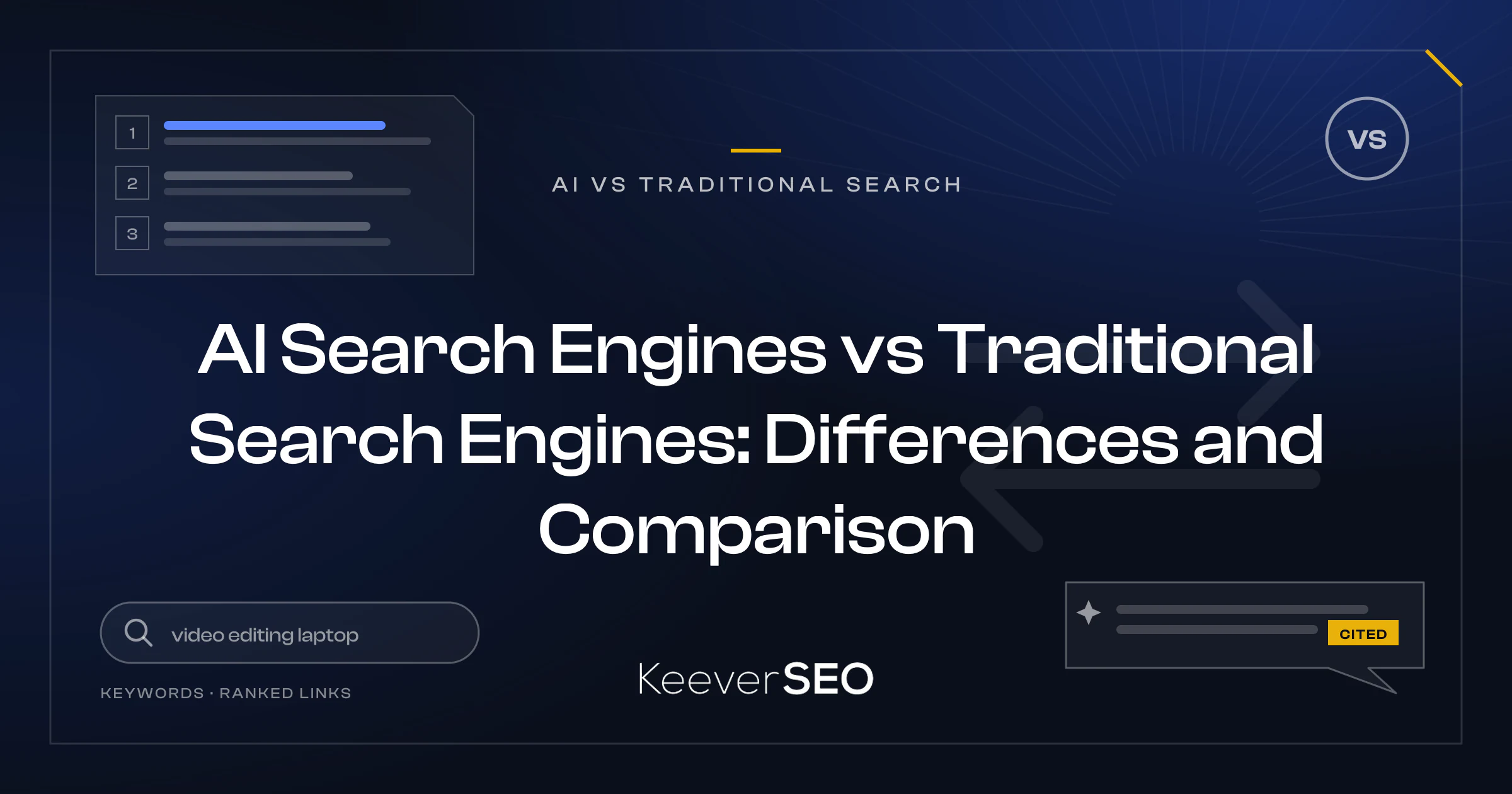
AI search engines generate direct answers from retrieved sources, while traditional search engines return ranked links for users to open and evaluate. A traditional search engine crawls web pages, stores them in an index, and ranks results by relevance and other signals. An AI search engine retrieves relevant information, then uses a generative model to synthesize an answer, with citations and conversational follow-ups in most products.
The two search types differ in query style, output, research effort, verification, traffic, and personalization. AI search handles full questions and produces summaries, while traditional search responds to keywords with a results page. AI answers can save research time but may contain errors, so users should check cited sources, and traditional results give users direct access to pages for comparison. Pew Research Center found that users clicked a traditional result in 8% of visits when an AI summary appeared, compared with 15% when it did not. AI search may bring fewer referrals, while traditional search can generate more clicks, and both can reach high-intent audiences.
Traditional search engines already use machine learning, and modern products increasingly combine ranked links with generated answers. AI is not only search, since assistants can generate content without retrieving web pages. Traditional search suits navigation, local results, shopping comparisons, and primary-source checks, while AI search suits complex questions, summaries, and follow-up research. The two are developing into hybrid experiences rather than one replacing the other. Businesses can support both by strengthening technical SEO and publishing clear, structured, authoritative content, then measuring rankings, clicks, conversions, AI citations, mentions, and referrals. The comparison table below summarizes the differences at a glance.
What Is the Difference Between AI Search Engines and Traditional Search Engines at a Glance?
The difference between AI search engines and traditional search engines at a glance is that AI search engines synthesize one answer, while traditional search engines rank pages for users to open.
| Dimension | AI Search Engines | Traditional Search Engines |
|---|---|---|
| Query input | Accept conversational questions and follow-up prompts, using context from the exchange. | Work well with concise keywords and phrases, while supporting natural-language queries. |
| Output format | Generate a synthesized answer, with citations or links to sources in most products. | Present a ranked results page with links, titles, snippets, and other search features. |
| Speed | Provide a direct summary that can reduce initial research effort. | Require users to review results and open sources to assemble information. |
| Accuracy and verification | Synthesize retrieved sources, but answers may omit context or contain errors. Citations help users verify claims. | Let users inspect and compare source pages directly, while requiring users to assess the information. |
| Website traffic | May answer queries without a click, while sending some users to cited sources for further reading. | Direct users to websites through ranked results and support source-by-source browsing. |
| Personalization | Uses conversational context and follow-up questions, and some systems use saved context. | Uses signals such as location, language, search history, device, and settings. |
| Examples | Perplexity, ChatGPT Search, Google AI Overviews, and Microsoft Copilot. | Google Search, Bing, Yahoo, DuckDuckGo, Baidu, Yandex, and Brave Search. |
What Is a Traditional Search Engine?
A traditional search engine is a web-based system that finds and organizes online information, then displays relevant pages as ranked links. Google and Bing use automated crawlers to find webpages, build searchable indexes, and rank results against a user's query.
The results page lets users open websites, documents, images, or videos and evaluate the sources themselves. Traditional search engines retrieve existing content rather than composing one answer from multiple sources.
How Do Traditional Search Engines Crawl, Index, and Rank Pages?
Traditional search engines crawl, index, and rank pages in three stages. Crawlers find new or updated pages by following links and other discovery methods, then retrieve accessible content.
During indexing, search engines analyze page text, images, metadata, and other signals before storing information in a searchable database. Ranking algorithms then order eligible pages according to relevance, quality, language, location, and device, and discovery does not guarantee indexing or ranking.
What Is an AI Search Engine?
An AI search engine is a tool that uses artificial intelligence to interpret questions, retrieve relevant information, and generate direct answers. Unlike a traditional search engine, an AI search engine synthesizes information from sources instead of presenting only a ranked list of links.
AI search engines cite or link to retrieved sources in most products, which lets users check the evidence behind an answer. Perplexity and ChatGPT Search are examples of AI search tools that combine information retrieval with generated responses.
Many AI search engines support conversational follow-ups. The AI search system uses context from earlier questions to answer refinements without requiring users to restate the entire query.
How Do AI Search Engines Generate Answers?
AI search engines generate answers by retrieving relevant information and synthesizing selected passages into a conversational response. Retrieval-augmented generation (RAG) connects a language model to search indexes, databases, or live web sources, grounding its answer in retrieved material.
The system ranks passages by relevance, credibility, freshness, and how directly they address the query. The language model combines the strongest passages with the user's question to produce one reply, and citations can link claims to sources without guaranteeing complete support for every statement.
What Are the Key Differences Between AI and Traditional Search Engines?
The key differences between AI and traditional search engines lie in how each handles queries and presents information. AI search engines retrieve relevant sources and synthesize answers, while traditional search engines rank webpages for users to open and compare.
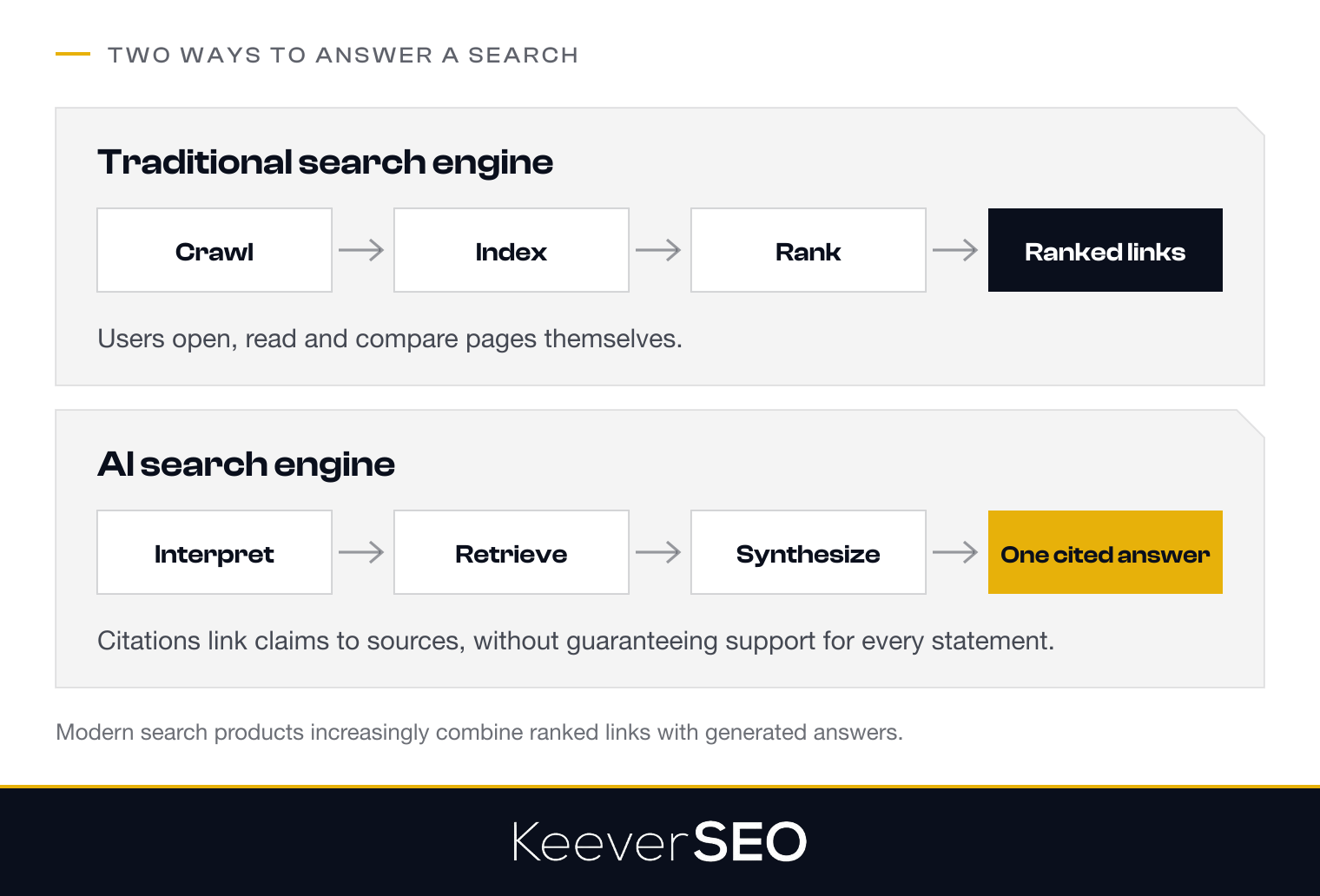
The comparison covers six dimensions: query input, output format, speed and research effort, accuracy and verification, website traffic, and personalization. Each dimension shows how AI search and traditional search serve different research needs.
How Do AI and Traditional Search Engines Differ in Query Input?
AI and traditional search engines differ in query input because AI search engines accept full conversational questions, while traditional search engines have historically favored short keyword queries. A user can ask an AI search engine, "Which laptop is best for video editing under $1,000?" and refine the request with follow-up questions.
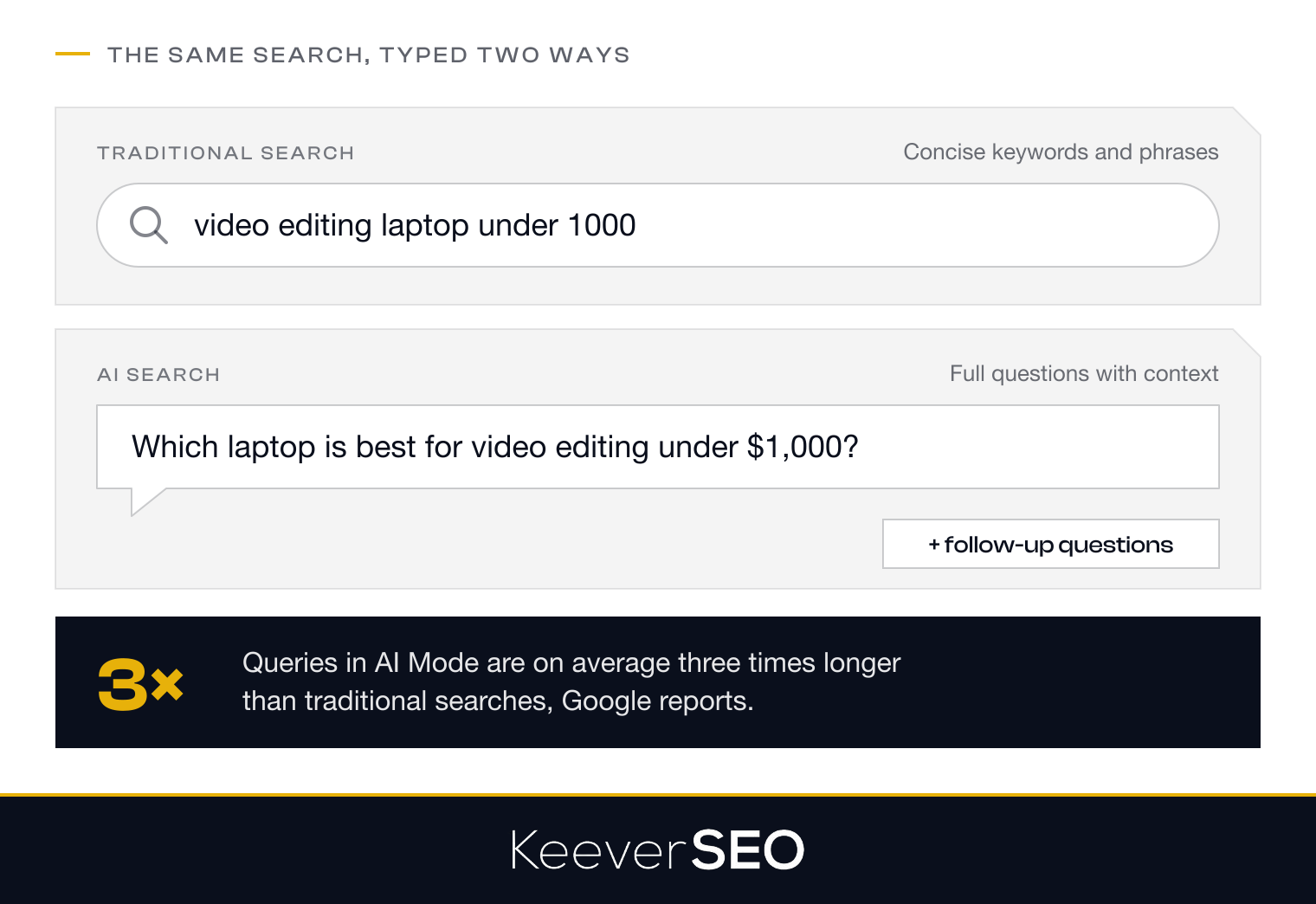
Traditional search engines match concise phrases, such as "video editing laptop under 1000," with relevant pages in their index. Modern search engines increasingly handle natural-language questions, but conversational context and follow-up handling remain defining features of AI search, where Google reports that "queries in AI Mode are on average three times longer than traditional searches."
How Do AI and Traditional Search Engines Differ in Output Format?
AI and traditional search engines differ in output format because AI search engines present a synthesized answer that combines information from retrieved sources, with citations or links for verification. Users can read one conversational response instead of assembling information from separate webpages.
Traditional search engines display a ranked list of webpages with titles, URLs, and snippets. Users open and compare the links to build their own answer.
How Do AI and Traditional Search Engines Differ in Speed and Research Effort?
AI and traditional search engines differ in speed and research effort because AI search engines summarize information from retrieved sources in a single response. Traditional search engines return ranked links, so users open, read, and compare several pages themselves.
AI summaries save time, but users should check cited sources when accuracy or current information matters.
How Do AI and Traditional Search Engines Differ in Accuracy and Verification?
AI and traditional search engines differ in accuracy and verification because AI search engines can produce unsupported or inaccurate statements, while traditional search engines present pages users can inspect and compare. "Collectively, they provided incorrect answers to more than 60 percent of queries," according to "AI Search Has a Citation Problem" by Klaudia Jaźwińska and Aisvarya Chandrasekar, published by the Columbia Journalism Review in March 2025, in a test of eight AI tools identifying news sources.
Traditional search results make source checking more direct because users can open original webpages and assess their evidence. AI answers can speed up research, but users should verify important claims against cited sources or primary documents.
How Do AI and Traditional Search Engines Differ in Website Traffic?
AI and traditional search engines differ in website traffic because traditional search engines send more visitors through ranked links, while AI search engines provide direct answers that reduce outbound clicks. "AI platforms now account for 0.32% of all website traffic," according to "Analysis of Top AI Search Engines: Who Is Catching Up to ChatGPT?" by Yulia Deda, published by SE Ranking in June 2026.
Clicks fall when AI answers appear inside search too: Pew Research Center found that users clicked a traditional result in 8% of visits with an AI summary, compared with 15% without one, according to "Google users are less likely to click on links when an AI summary appears in the results" by Athena Chapekis and Anna Lieb, July 2025.
How Do AI and Traditional Search Engines Differ in Personalization?
AI and traditional search engines differ in personalization because AI search engines personalize answers using the current conversation, earlier prompts, and, when turned on, remembered preferences. Conversation context helps an AI search engine shape follow-up responses without requiring users to repeat details.
Traditional search engines personalize ranked results using signals such as search history, location, language, device type, and the current query. Account settings and user consent affect which personalization signals each search platform uses.
Do Traditional Search Engines Already Use AI?
Yes, traditional search engines already use AI, and Google and Bing have used machine learning for years to interpret queries and rank search results. Google's "A Guide to Google Search Ranking Systems" describes RankBrain as "an AI system that helps us understand how words are related to concepts" and says BERT is an AI system that shows "how combinations of words express different meanings and intent." Bing uses machine-learning models to rank pages in its search index, and both now add AI-generated answers alongside traditional ranked links.
Is AI Just a Search Engine?
No, AI is not just a search engine, because AI assistants can generate explanations, summarize documents, draft content, and analyze files. AI assistants perform many tasks using trained knowledge or connected files without conducting a live web search. Search engines retrieve and rank existing webpages from an index for users to inspect. When an AI assistant uses web search, it combines retrieved sources with generated responses and citations.
When Should You Use AI Search vs Traditional Search?
You should use AI search or traditional search according to the task. Traditional search suits finding known websites, local information, product options, and primary sources, while AI search suits complex questions, cross-source summaries, and conversational research.
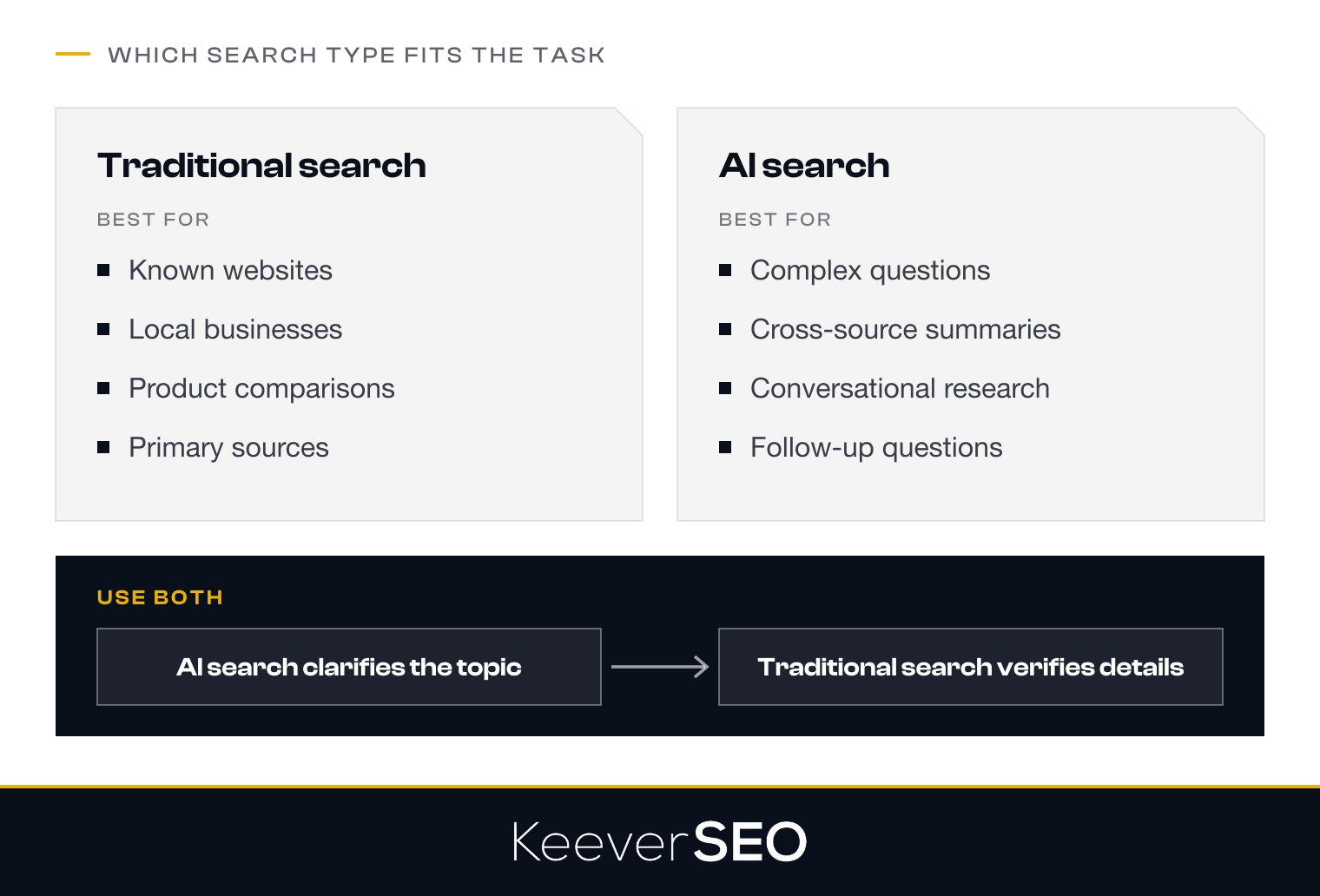
AI search can clarify a topic before traditional search verifies important details against original sources. The sections below explain when each search type offers the better fit.
When Is Traditional Search the Better Choice?
Traditional search is the better choice when you need to reach a known website, find local businesses, compare products, or verify information. Google and Bing provide dedicated results for Maps, Shopping, News, images, and web pages. Search filters and operators help you narrow results by location, date, exact phrase, or website. For important or time-sensitive claims, open and assess the original source rather than relying only on a summary.
When Is AI Search the Better Choice?
AI search is the better choice for complex questions that need explanation rather than one webpage. AI search summarizes information from multiple sources into a direct answer, which reduces the effort of comparing separate pages. Conversational follow-up questions let users dig into related details within the same context. Check important claims against cited primary or authoritative sources, because AI answers can contain errors or omit relevant information.
Will AI Search Engines Replace Traditional Search Engines?
No, AI search engines are unlikely to replace traditional search engines and are more likely to merge with them. Search platforms increasingly combine generated summaries with ranked links, and Google says it is "building one seamless experience across AI Overviews, AI Mode, and traditional Search," in its Q3 2026 earnings remarks.
Usage data points the same way. Semrush's August 2025 study "ChatGPT Is Not Replacing Google—It's Expanding Search" found "no statistically significant change in daily Google Search sessions once people start using ChatGPT for the first time," and SparkToro reported that 95% of Americans still use traditional search engines every month. Traditional search remains useful for navigation, local listings, product comparisons, and source verification, while AI search supports summaries and complex research.
How Should Businesses Adapt to Both AI and Traditional Search?
Businesses should adjust to both AI and traditional search by using SEO as the foundation for visibility across both. Crawlable pages, useful people-first content, strong internal links, and a positive page experience support traditional rankings and provide reliable material for AI systems to retrieve.
For AI visibility, businesses should answer common questions directly, organize information with clear headings, use accurate structured data where appropriate, and build credible brand mentions on reputable websites. Structured data can clarify page information, but no special schema guarantees placement in AI answers. Businesses should measure traditional search performance and AI visibility as separate outcomes.
How Do You Measure Results Across AI and Traditional Search?
To measure results across AI and traditional search, track keyword rankings, impressions, clicks, click-through rate, organic sessions, and conversions for traditional search. Google Search Console reports search impressions, clicks, average position, queries, and landing pages.
AI search measurement tracks brand mentions, answer share of voice, citations, cited URLs, and referral visits from AI platforms. Citations may not produce clicks, so businesses compare AI visibility with branded-search growth, assisted conversions, lead quality, and sales using a shared conversion framework.
How Does Keever SEO's AI Optimization Service Cover Both AI and Traditional Search Engines?
Keever SEO's AI optimization service covers both AI and traditional search engines by combining SEO ranking work with strategies for visibility in AI-generated answers. The traditional SEO work covers technical improvements, on-page content, off-page signals, and keyword rankings.
For AI search visibility, the hybrid search SEO agency service audits brand presence across ChatGPT, Perplexity, Gemini, and Google AI Overviews. Keever SEO improves answer-first content, structured data, entity clarity, and brand mentions, then tracks citations, share of voice, sentiment, and AI referral traffic alongside search rankings.
How Does Optimization Differ for AI and Traditional Search?
Optimization differs for AI and traditional search because traditional SEO optimizes web pages to rank in search results and earn clicks, while AI search optimization structures clear, authoritative content to help systems retrieve, synthesize, and cite information in generated answers. GEO focuses on earning brand mentions and citations in AI responses, while AEO makes concise answers easier to extract. Both approaches build on sound SEO practices, but they target different forms of visibility.
How Does GEO Differ From Traditional SEO?
GEO differs from traditional SEO because Generative Engine Optimization aims to get a brand or its content mentioned, cited, summarized, or recommended in AI-generated answers, while traditional SEO focuses on ranking webpages in search results to earn visibility, clicks, and website traffic.
How Does AEO Differ From SEO?
AEO differs from SEO because Answer Engine Optimization structures content so AI and answer engines can extract concise responses and cite their sources, while Search Engine Optimization improves a page's visibility in ranked organic listings, with results measured through rankings, impressions, and clicks.
How Do Traditional Search Engines Work Under the Hood?
Traditional search engines work under the hood by finding web pages through crawlers that follow links and other URL-discovery methods. Search engines analyze page content, images, and metadata, then store that information in a searchable index. Ranking systems select and order relevant indexed pages using signals such as content quality, links, language, location, device, and freshness. Google describes crawling, indexing, and serving search results as the core stages of its search process in its "In-Depth Guide to How Google Search Works."
Which Traditional Search Engines Exist Beyond Google?
The traditional search engines that exist beyond Google include Bing, Yahoo, DuckDuckGo, Yandex, Baidu, and Brave Search. Bing serves general web searches, Yahoo Search largely uses Bing results, and DuckDuckGo centers on privacy, while Yandex is prominent in Russian-language search, Baidu in Chinese-language search, and Brave Search operates its own independent index.
How Do AI Search Engines Compare With Each Other?
AI search engines compare with each other in how they cite sources, access web information, and support different tasks. Perplexity searches the live web and places citations throughout answers, which makes it useful for source-focused research and summaries. ChatGPT Search combines web retrieval with writing, analysis, and follow-up conversation, while Gemini connects search with Google services such as Docs and Gmail. Microsoft Copilot suits searches within Microsoft workflows, and Google AI Mode and AI Overviews draw on Google Search for everyday queries.
Which Search Engine Type Fits Your Needs?
The search engine type that fits your needs depends on the task. Traditional search suits navigation to a known website, finding local businesses, and checking primary sources, and ranked links let users inspect original information and compare results.
AI search suits complex questions, explanations, and summaries across multiple sources. AI search engines synthesize answers, while traditional search engines prioritize link discovery and verification.