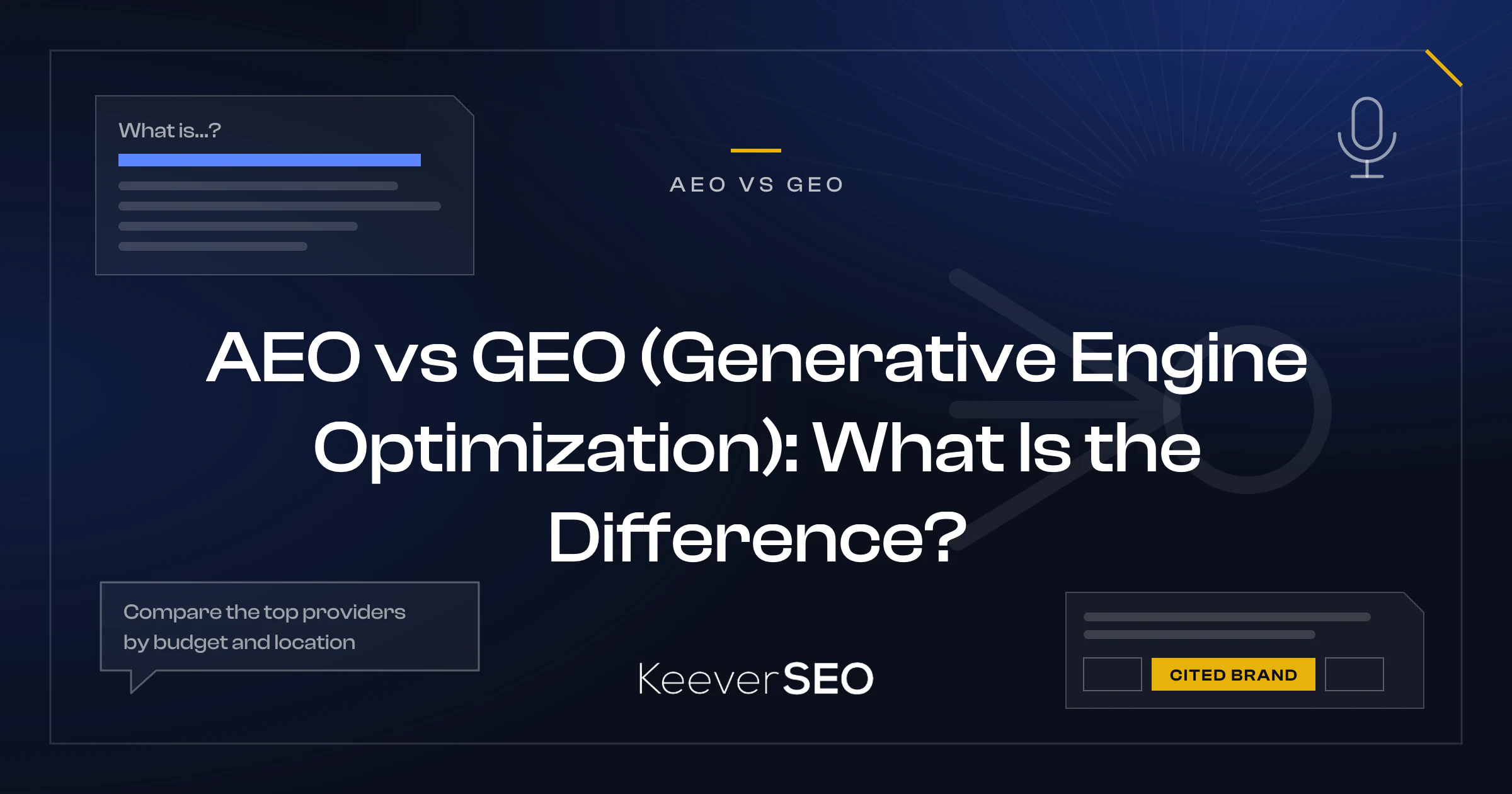
The difference between AEO and GEO is that AEO optimizes content for extraction as a direct answer, while GEO optimizes brand visibility and citations within AI-generated responses. Answer engine optimization targets question-led results such as featured snippets, voice answers, and Google AI Overviews. Generative engine optimization targets responses from platforms such as ChatGPT, Gemini, Perplexity, and Claude. AEO favors concise question-and-answer passages, and GEO favors authoritative, well-sourced content that AI systems can cite. AEO measures answer placements and snippet ownership, while GEO tracks brand mentions, citation share, and AI referral traffic.
AEO and GEO overlap through clear structure, trusted sources, and consistent brand information, but neither replaces traditional SEO. SEO supports crawlability, indexing, and organic visibility, and AEO and GEO extend that foundation into extracted answers and generative responses. Many practitioners use AEO and GEO as interchangeable terms, while others distinguish direct answer extraction from brand inclusion. Businesses can prioritize AEO for service questions and voice searches, then add GEO as customers use AI assistants to research and compare providers. Local service businesses can use both: answer-ready service pages support AEO, while reviews, third-party mentions, and consistent business details support GEO.
A combined AEO and GEO program builds brand authority, structures content for clear answers, and tracks citations across AI platforms. GEO services add brand-mention monitoring, prompt testing, and citation analysis, and the core measures include mention rate, citation share, and AI referral traffic. Google AI Overviews, ChatGPT, and Perplexity draw on different sources, so businesses should assess visibility separately on each platform. The at-a-glance comparison below summarizes the distinction between direct answer extraction and inclusion in AI-generated responses.
What Is the Difference Between AEO and GEO at a Glance?
The difference between AEO and GEO at a glance is that answer engine optimization (AEO) helps answer engines extract direct responses, while generative engine optimization (GEO) helps brands earn inclusion and citations in AI-generated responses. The main differences appear in goals, platforms, query types, content formats, and success measures.
| Dimension | AEO | GEO |
|---|---|---|
| Goal | Make content the direct answer to a user's question. | Increase brand inclusion and citations in AI-generated responses. |
| Target platforms | Featured snippets, voice assistants, answer panels, and Google AI Overviews. | ChatGPT, Perplexity, Gemini, Claude, and other generative AI platforms. |
| Query type | Focused questions seeking a fact, definition, instruction, or brief solution. | Research, comparison, and recommendation prompts requiring information synthesis. |
| Content format | Concise answers, definitions, lists, tables, and step-by-step instructions. | Authoritative, statistic-rich content with clear entities and attributable claims. |
| Success metrics | Answer placement, featured-snippet ownership, voice-answer selection, and AI summary visibility. | Brand mention rate, citation share, source inclusion, response prominence, and AI referral traffic. |
What Is Answer Engine Optimization (AEO)?
Answer engine optimization (AEO) is the practice of structuring content so search and AI systems can extract it as a direct answer. AEO aims to make a clear, relevant passage the response to a user's question, rather than only placing a webpage among search results.
Answer engine optimization grew out of efforts to appear in Google featured snippets, People Also Ask results, and voice search answers. Current AEO practice structures concise answers and supporting information for AI-powered search features, including Google AI Overviews.
What Is Generative Engine Optimization (GEO)?
Generative engine optimization (GEO) is the practice of increasing a brand's chances of being mentioned or cited in AI-generated responses. GEO targets large language model platforms such as ChatGPT, Perplexity, Gemini, and Claude, where systems synthesize information from multiple sources rather than listing ranked links.
The term "generative engine optimization" comes from the November 2023 research paper "GEO: Generative Engine Optimization" by Pranjal Aggarwal, Vishvak Murahari, Tanmay Rajpurohit, Ashwin Kalyan, Karthik Narasimhan, and Ameet Deshpande, later accepted to KDD 2024. The paper introduced GEO as a framework for improving content visibility in generative engine responses and reported that GEO "can boost visibility by up to 40% in generative engine responses."
What Are the Key Differences Between AEO and GEO?
The key differences between AEO and GEO start with the optimization goal: AEO helps answer engines extract a direct response, while GEO helps AI systems include and cite a brand in generated answers.
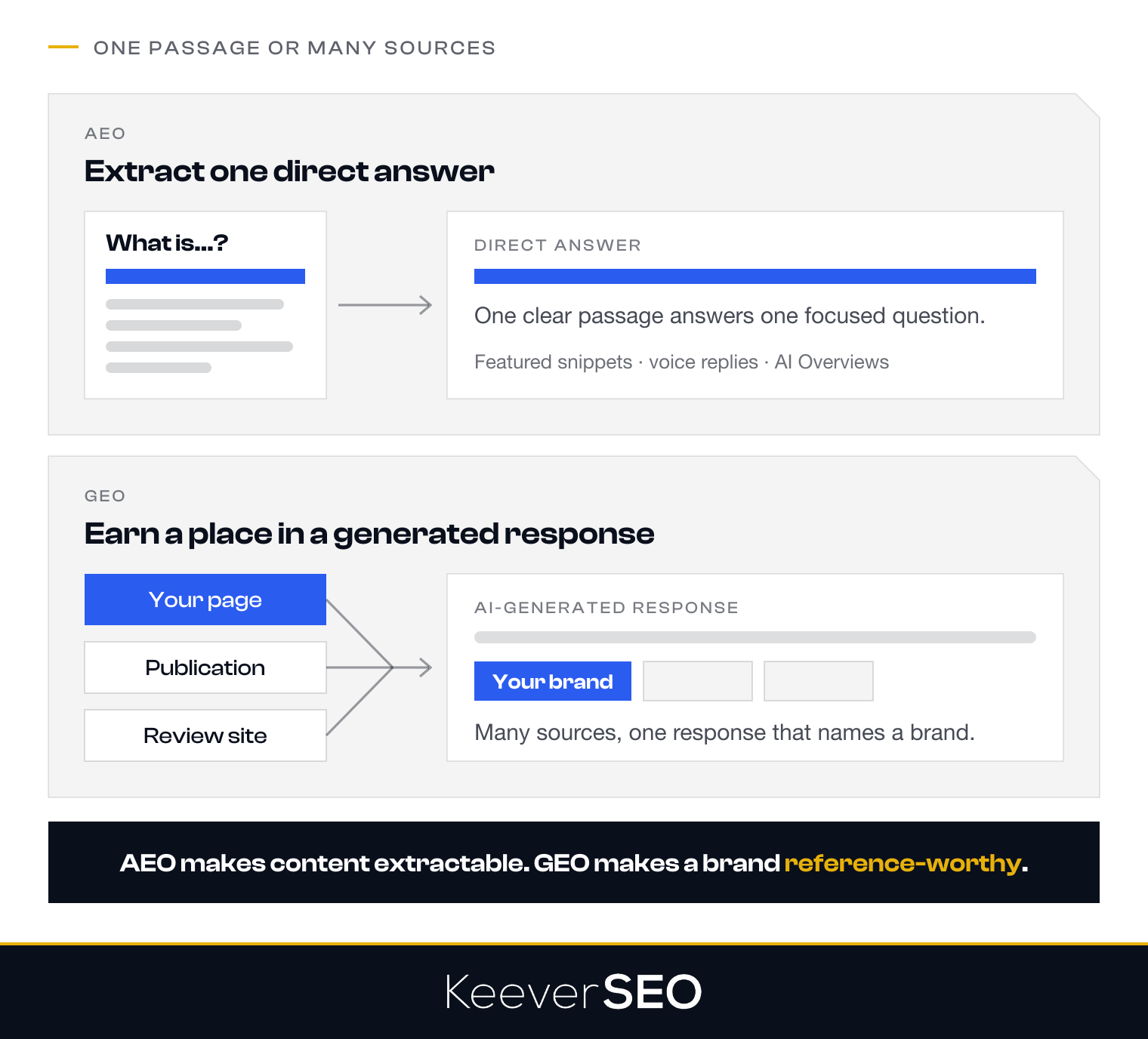
AEO and GEO target different platform experiences, content formats, and success metrics. The sections below compare their goals, platforms, answer-ready content, and visibility measures.
How Do AEO and GEO Differ in Optimization Goal?
AEO and GEO differ in optimization goal because answer engine optimization aims to make one passage the direct answer to a user's question, while generative engine optimization aims to place a brand or source within an AI-generated response. AEO targets answer ownership, such as a featured snippet or a voice-assistant reply.
GEO focuses on brand mentions and citations within responses that synthesize information from multiple sources. AEO optimizes an answer for extraction, and GEO raises a brand's chance of being named and cited as a source.
How Do AEO and GEO Differ in Target Platforms?
AEO and GEO differ in target platforms because AEO targets Google featured snippets, voice assistants, and direct-answer features such as Google AI Overviews. Answer platforms surface concise answers to focused questions, so AEO concentrates on making page content easy to extract.
GEO targets generative AI platforms such as ChatGPT, Gemini, Perplexity, and Claude, where answers mention brands and cite sources. Google AI Overviews supports both approaches, so the distinction depends on whether a business seeks an extracted answer or broader inclusion in an AI-generated response.
How Do AEO and GEO Differ in Content Format?
AEO and GEO differ in content format because AEO content uses concise, self-contained question-and-answer passages, while GEO content uses evidence-rich sources with statistics, expert quotations, and citations that support AI-generated responses.
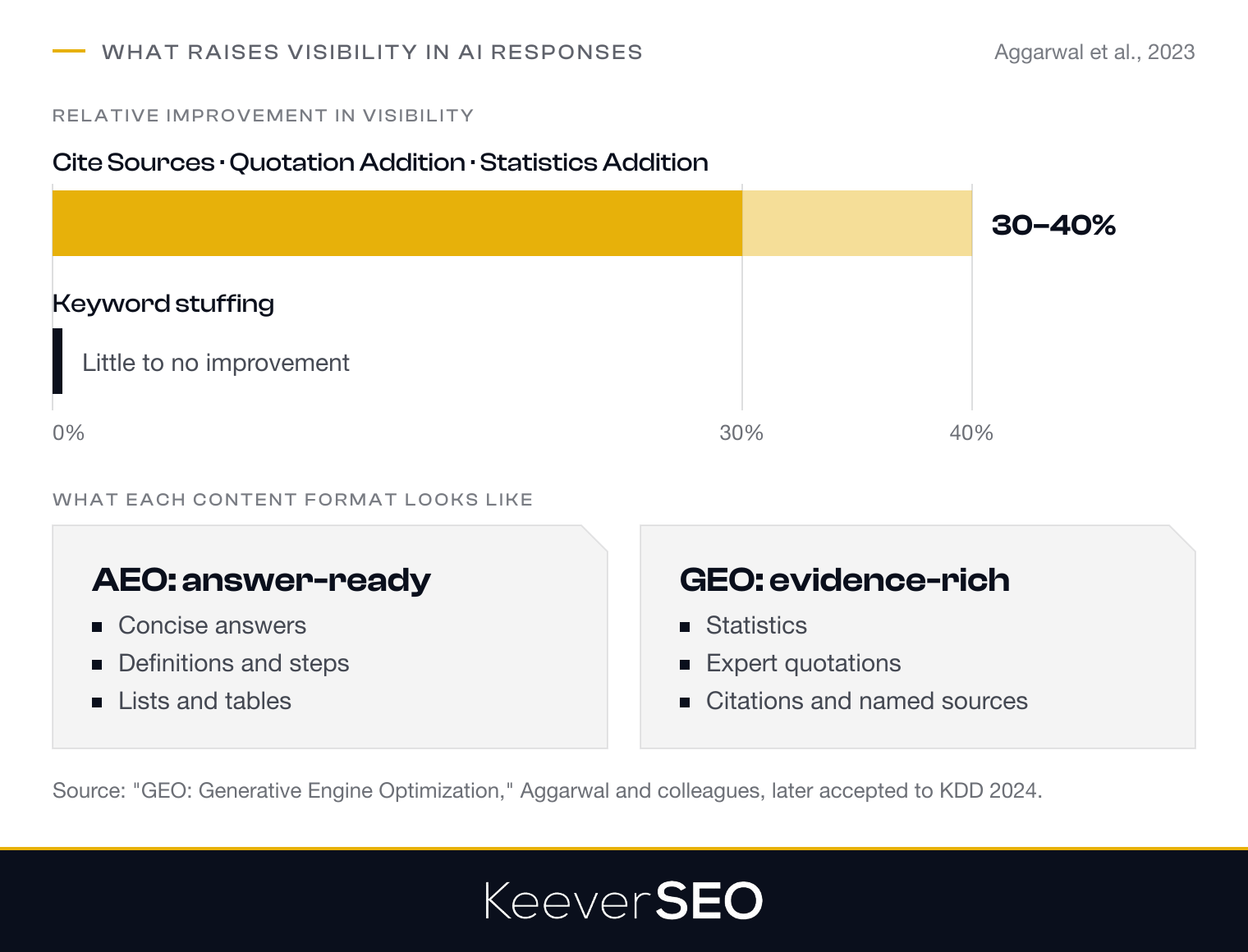
A 2023 study by Aggarwal and colleagues, "GEO: Generative Engine Optimization," found that the top methods, Cite Sources, Quotation Addition, and Statistics Addition, "achieved a relative improvement of 30-40%" in visibility, while keyword stuffing offered "little to no improvement on generative engine's responses." The findings support verifiable evidence and clear sourcing for GEO, alongside answer-ready passages for AEO.
How Do AEO and GEO Differ in Success Metrics?
AEO and GEO differ in success metrics because AEO measures whether a page earns a direct answer placement, such as a featured snippet or an answer position in Google AI Overviews. AEO reporting tracks snippet ownership, visibility for question-based searches, and impressions or clicks from answer placements.
GEO measures how often AI-generated responses mention a brand, cite its content, or send visitors to its website. The core GEO metrics are brand mention rate, citation share, and referral traffic from platforms such as ChatGPT and Perplexity.
Are AEO and GEO the Same Thing?
No, AEO and GEO are not strictly the same thing, although many practitioners use both terms for the same effort to improve brand visibility in AI-generated answers. Other practitioners define AEO as optimizing content for direct answer extraction and GEO as increasing brand mentions or citations in generated responses. Google treats both labels as one discipline: "From Google Search's perspective, optimizing for generative AI search is optimizing for the search experience, and thus still SEO," according to "Google's Guide to Optimizing for Generative AI Features on Google Search," published by Google Search Central in May 2026. Despite the naming debate, AEO and GEO share practical methods, including clear answers, credible sources, and strong brand authority.
Where Do AEO and GEO Overlap?
AEO and GEO overlap because both help AI search systems interpret, trust, and reuse a brand's information. Both disciplines rely on authoritative content, clear structure, accurate entity details, and mentions from reputable third-party sources.
Consistent brand facts, expert content, customer reviews, and independent references support both answer extraction and brand citations. AEO stresses concise, answer-ready passages, while GEO stresses brand inclusion in generated responses.
How Do AEO and GEO Differ From Traditional SEO?
AEO and GEO differ from traditional SEO because traditional SEO optimizes web pages to rank in search results and earn clicks, while AEO structures content for direct answers and GEO improves a brand's inclusion and citations in AI-generated responses.
SEO still supports AEO and GEO because search engines and AI systems need discoverable, crawlable, authoritative content. Strong SEO helps systems find and assess a page, but SEO does not guarantee a direct answer placement or an AI citation.
When Should a Business Prioritize AEO vs GEO?
A business should prioritize AEO when customers seek direct answers through question-led searches, voice queries, featured snippets, or Google AI Overviews, and GEO when customers use AI assistants to research, compare, or request provider recommendations. AEO suits businesses that want their content selected as a concise answer.
Most businesses benefit from both AEO and GEO, with the balance guided by customer search behavior and the desired visibility outcome.
When Should a Business Prioritize AEO?
A business should prioritize AEO when customers use question-led searches to find quick, direct answers. AEO suits queries beginning with "what," "how," "where," "when," or "why," along with voice searches that favor concise responses. Businesses should focus on target keywords that trigger featured snippets or Google AI Overviews. Answer-first passages, short definitions, and clear steps help search systems extract the right information.
When Should a Business Prioritize GEO?
A business should prioritize GEO when customers use ChatGPT, Gemini, Perplexity, or Claude for research and recommendations. Generative engine optimization helps a brand appear as a credible, citable option in AI-generated responses. GEO matters most in categories where buyers ask AI tools to compare providers by budget, location, or individual needs. Authoritative, current content and consistent third-party mentions support brand visibility in those answers.
How Do You Use AEO and GEO Together?
To use AEO and GEO together, follow three steps: build brand authority across trusted sources, structure owned content for direct answers and AI parsing, and track mentions and citations across platforms. The combined approach supports answer extraction and brand visibility in AI-generated responses.
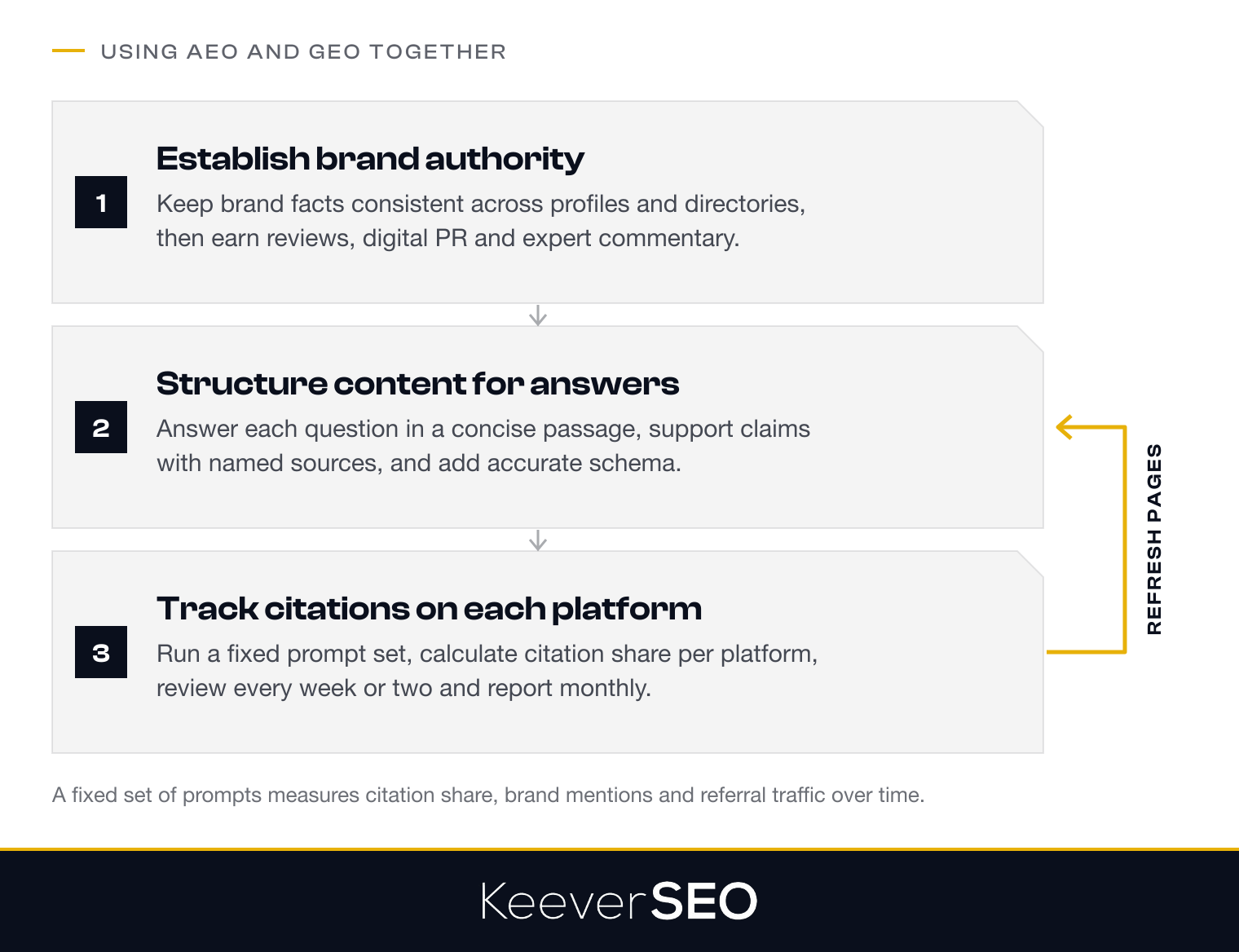
A fixed set of relevant prompts measures citation share, brand mentions, and referral traffic over time. The first step is establishing consistent brand authority across trusted sources.
1. Establish Brand Authority Across Trusted Sources
Establishing brand authority across trusted sources makes AEO and GEO work, because answer engines rely on sources that describe a brand consistently. Keep the business name, category, services, locations, products, differentiators, and key people accurate across the website, business profiles, directories, review platforms, and social channels. Consistent brand facts help AI systems identify the business as a distinct entity.
Build authority beyond owned channels through genuine customer reviews, relevant digital PR, industry publications, expert commentary, and original research. Earned mentions give answer engines and generative AI systems credible context for citing or recommending a brand. Clear authority gives structured content stronger grounding for accurate answer extraction.
2. Structure Content for Answer Extraction and AI Parsing
Structuring content for answer extraction and AI parsing helps answer engines extract direct responses and helps generative engines interpret supporting details. Use descriptive question headings, then answer each question in a concise passage before adding context, examples, or qualifications. Support statistics and factual claims with named sources, publication dates, and links so AI systems and readers can verify the evidence.
Schema markup describes page content in a machine-readable format. Add accurate markup that matches visible content, such as Article, Organization, or LocalBusiness, and keep in mind that Google stopped showing FAQ rich results in May 2026 and that "Google does not guarantee that your structured data will show up in search results," according to Google's "General Structured Data Guidelines." Once answer-ready pages are structured and published, track which AI platforms cite them and where their citations change.
3. Track Citations Across Each AI Platform
Tracking citations across each AI platform starts with a fixed set of representative prompts across Google AI Overviews, ChatGPT, Perplexity, and other priority platforms. Keep location, language, personalization, and competitor sets consistent, then record brand mentions, answer position, descriptions, cited pages, and named competitors.
Calculate citation share separately for each platform by comparing your brand's citations with competitors' citations across the same prompts. Review results weekly or every two weeks, report monthly trends, and refresh pages when they lose citations or contain outdated information.
Do Local Service Businesses Need AEO, GEO, or Both?
Local service businesses need both AEO and GEO, with AEO as the best starting point. Answer-ready pages address service questions about pricing, coverage areas, timelines, eligibility, and emergencies, while GEO helps AI assistants identify the business in local recommendations.
Use of ChatGPT and other generative AI tools for local recommendations rose "from 6% last year to 45%," according to the "Local Consumer Review Survey 2026" by Rosie Murphy, published by BrightLocal in February 2026. As more customers ask AI assistants to compare local providers, accurate business listings, consistent service details, strong reviews, and trusted third-party mentions support GEO visibility.
What Do Generative Engine Optimization Services Add to an AEO Program?
Generative engine optimization services add off-site brand building and AI response tracking to an AEO program that focuses on making website content easy to extract. GEO services build brand mentions and citations through relevant publications, industry websites, reviews, and other trusted sources that AI platforms draw on when generating answers.
GEO services track a fixed set of customer prompts across platforms such as ChatGPT, Perplexity, and Google AI Overviews. GEO services monitor brand mentions, citations, and competitor visibility while aligning company facts, such as services, locations, and products, across the website and external profiles.
How Does Keever SEO Run Answer Engine Optimization Alongside GEO?
Keever SEO runs answer engine optimization alongside GEO in one AI visibility program. A GEO and SEO agency AI visibility audit benchmarks brand mentions, citations, competitors, and search positions across ChatGPT, Perplexity, Gemini, and Google AI Overviews.
The Keever SEO program uses answer-first content, schema markup, consistent brand information, and citation building across authoritative websites, directories, forums, and communities. Keever SEO reports citation frequency, brand mentions, AI share of voice, sentiment, and referral traffic by platform, then refreshes content when citation patterns change.
How Do AEO and GEO Apply to Each AI Search Platform?
AEO and GEO apply differently to each AI search platform because Google AI Overviews, ChatGPT, and Perplexity retrieve and present information in different ways. Google AI Overviews favor search-visible pages with clear, answer-ready passages. ChatGPT visibility depends more on accessible content, consistent brand facts, and corroboration from trusted sources. Perplexity rewards current, evidence-backed pages that answer focused questions and provide verifiable citations.
Which Sources Do Google AI Overviews Cite?
The sources Google AI Overviews cite are a mix of top-ranking pages, lower-ranking pages, forums such as Reddit, and videos, especially from YouTube. "37.9% of URLs cited in AI Overviews also appeared within the first 10 blocks," with the rest split between positions 11 to 100 (31.2%) and beyond the top 100 (31.0%), according to the Ahrefs study "Update: 38% of AI Overview Citations Pull From The Top 10" by Louise Linehan, March 2026. The same Ahrefs analysis found that 18% of non-ranking AI Overview citations come from YouTube.
How Do You Get Your Brand Visible in ChatGPT?
To get your brand visible in ChatGPT, keep your website accessible to OpenAI's search crawler and make sure relevant pages appear in Bing's index. OpenAI's "Overview of OpenAI Crawlers" states that "sites that are opted out of OAI-SearchBot will not be shown in ChatGPT search answers." Build credible brand mentions across trusted publications, industry directories, reviews, and expert resources, and keep your business name, services, location, and descriptions consistent, since none of the steps guarantees placement in ChatGPT responses.
How Do You Get Your Brand Mentioned in Perplexity?
To get your brand mentioned in Perplexity, publish fresh, relevant pages with verifiable facts and clear citations that Perplexity's real-time search can find. Keep service and product pages current, and build consistent references across trusted publications, review sites, and helpful community discussions on Reddit, Quora, and niche forums.
Which GEO Ranking Factors Shape AI-Generated Answers?
The GEO ranking factors that shape AI-generated answers determine whether AI systems can identify, trust, and cite a source, although no universal ranking formula applies across platforms. The main GEO ranking factors are listed below:
- Source authority: Demonstrated know-how and credible references strengthen a source's trustworthiness.
- Statistics and quotations: Concrete data and attributed expert quotations give AI systems citable evidence, and the 2023 "GEO: Generative Engine Optimization" study found that Statistics Addition and Quotation Addition ranked among its top-performing methods.
- Content freshness: Current information supports citation potential, since "the average age of URLs cited by AI assistants is 1064 days, compared to 1432 days for URLs in organic SERPs," according to the Ahrefs study "New Study: AI Assistants Prefer to Cite 'Fresher' Content (17 Million Citations Analyzed)," July 2025.
- Entity clarity: Consistent descriptions of a brand, its services, and its know-how help AI systems connect the brand with relevant prompts.
- Third-party mentions: References from reputable publications, websites, and forums build independent evidence about a brand's relevance and authority, and Pew Research Center found that Wikipedia, YouTube, and Reddit accounted for 15% of the sources listed in Google's AI summaries in its July 2025 analysis.
How Do You Measure Generative Engine Optimization Results?
Generative engine optimization results are measured through brand mention rate, citation share, and LLM referral traffic. Brand mention rate tracks how often a brand appears in tested AI responses, while citation share measures the brand's proportion of cited sources. Track both metrics alongside visits from AI platforms, using a consistent prompt set across platforms and reporting periods.
Should Your Strategy Use AEO, GEO, or Both?
Your strategy should use both AEO and GEO on a strong SEO foundation. AEO structures content for direct answer extraction, while GEO builds brand visibility through mentions and citations in AI-generated responses. Traditional SEO supports both by helping search engines find and index authoritative content.
A combined strategy connects answer-ready content with consistent brand authority and citation tracking across AI platforms. The AEO-versus-GEO choice comes down to the distinction outlined above: AEO makes content extractable, while GEO makes a brand reference-worthy.