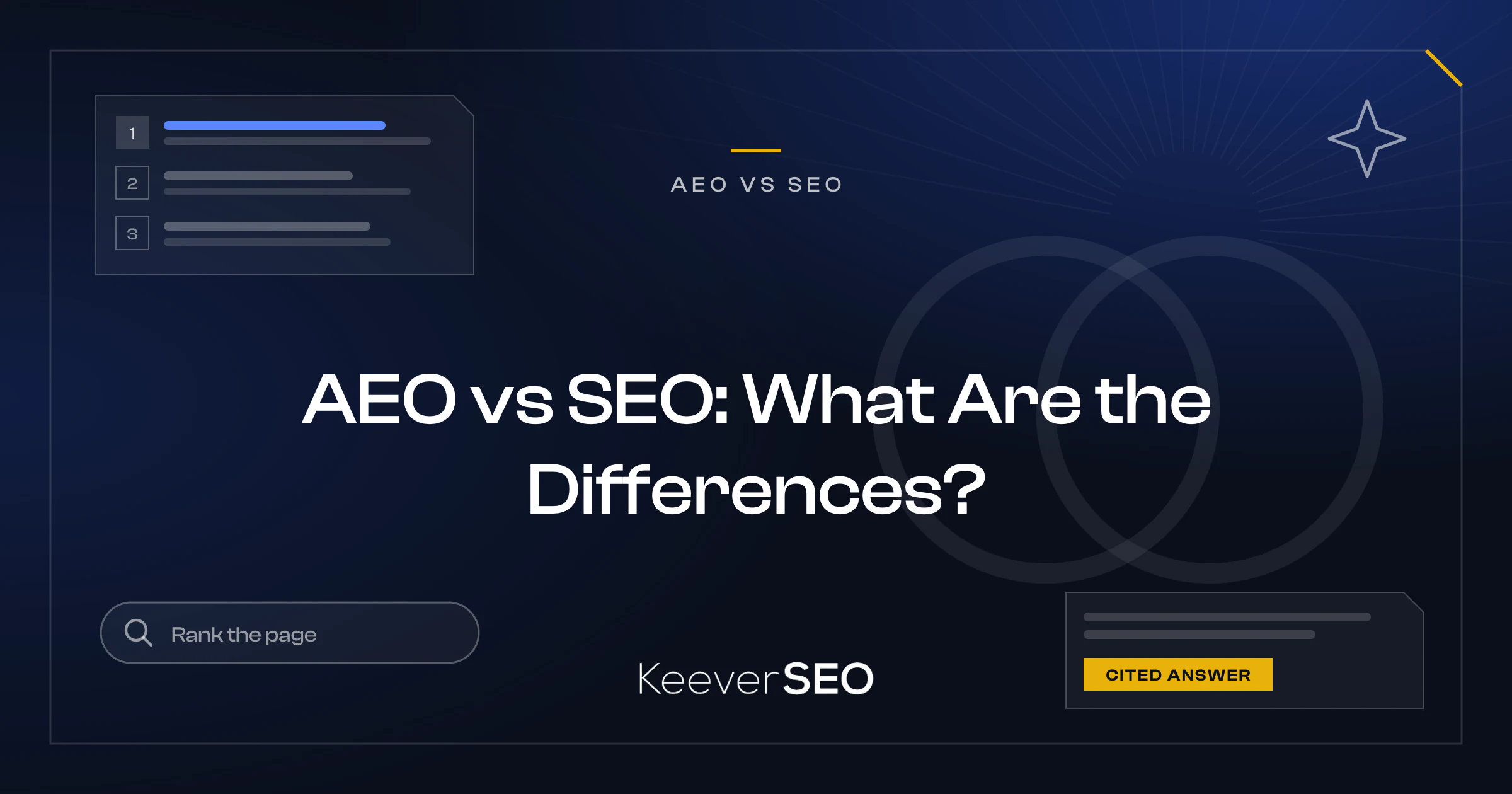
The differences between AEO and SEO come down to the outcome each one targets: answer engine optimization (AEO) prepares content for extraction and citation as answers by AI tools and search features, while search engine optimization (SEO) improves page rankings in organic results to earn clicks. AEO targets platforms such as Google AI Overviews, ChatGPT, and Perplexity with direct answers, structured passages, and clear supporting context, and marketers measure AEO through citations, brand mentions, and answer visibility. SEO targets Google and Bing organic listings with technically accessible, keyword-aligned pages, and marketers measure SEO through rankings, organic traffic, and click-through rates.
AEO addresses conversational questions and immediate information needs, while SEO reaches broader queries and supports detailed research. AEO and SEO share foundations in relevant content, technical accessibility, search intent, and brand authority. AEO does not replace SEO, and AEO requires more than adding an FAQ section: businesses should audit ranking pages for AI readiness, structure useful answers with appropriate schema, and build authority through reputable links and mentions. Question-heavy industries with established search visibility may lean toward AEO, while new sites, transactional campaigns, and local Map Pack strategies should prioritize SEO.
Local service businesses need SEO and Map Pack visibility as their foundation, with AEO extending reach across service questions answered by AI. Businesses evaluating an agency should review its ranking and citation reports, documented content and schema methods, and transparent authority-building work. AEO overlaps with generative engine optimization (GEO) and AI search, but the central distinction remains: SEO aims to win the ranked page, while AEO aims to win the cited answer. The comparison below breaks down that difference across the main dimensions.
What Is the Difference Between AEO and SEO at a Glance?
The difference between AEO and SEO at a glance is that AEO optimizes content for extraction and citation in AI-generated answers, while SEO optimizes pages to rank in organic search results and earn clicks.
| Dimension | AEO | SEO |
|---|---|---|
| Goal | Become a direct answer or cited source in AI-generated responses. | Rank prominently in organic search results and attract clicks. |
| Target platforms | Google AI Overviews, ChatGPT, Perplexity, Gemini, Bing Copilot, and voice assistants. | Google, Bing, and other search engines' organic results. |
| Query format | Conversational questions and natural-language prompts, such as "What is the best accounting software for a small business?" | Shorter keyword queries, such as "accounting software for small business." |
| Content format | Answer-first passages, concise explanations, lists, tables, and question-and-answer sections. | Keyword-targeted, in-depth pages supported by internal links and backlinks. |
| Success metrics | AI citations, brand mentions, share of voice, and visibility in generated answers. | Keyword rankings, organic impressions, traffic, click-through rate, and conversions. |
| Time to results | AI citations can shift within weeks after updates, depending on the platform and query. | Ranking and traffic gains take several months, especially for new sites or competitive topics. |
What Is Answer Engine Optimization (AEO)?
Answer engine optimization (AEO) is the practice of structuring content so AI-powered answer engines can extract and cite it in direct responses. AEO targets platforms such as Google AI Overviews, ChatGPT, and Perplexity, which draw on web sources to answer user questions.
AEO content uses clear definitions, direct answers, logical headings, and reliable evidence to make information easier to retrieve. The goal of answer engine optimization is to earn citations, brand mentions, and visibility within AI-generated answers, including responses that do not lead to a website click.
What Is Search Engine Optimization (SEO)?
Search engine optimization (SEO) is the practice of improving website pages so search engines can crawl, interpret, index, and rank them in organic results. SEO targets platforms such as Google and Bing, with the goal of attracting relevant unpaid visits through stronger visibility and rankings.
SEO combines technical, on-page, and off-page work. Technical SEO improves crawlability, indexing, site speed, and mobile usability, on-page SEO refines content, headings, titles, and internal links, and off-page SEO builds authority through backlinks and credible brand mentions. Strong SEO performance increases organic clicks and traffic.
What Are the Key Differences Between AEO and SEO?
The key differences between AEO and SEO lie in how each makes content visible: AEO helps answer engines extract and cite information, while SEO helps pages rank in organic search results and earn clicks. The main differences concern search intent and query format, target platforms, content format, technical requirements, success metrics, and time to results.
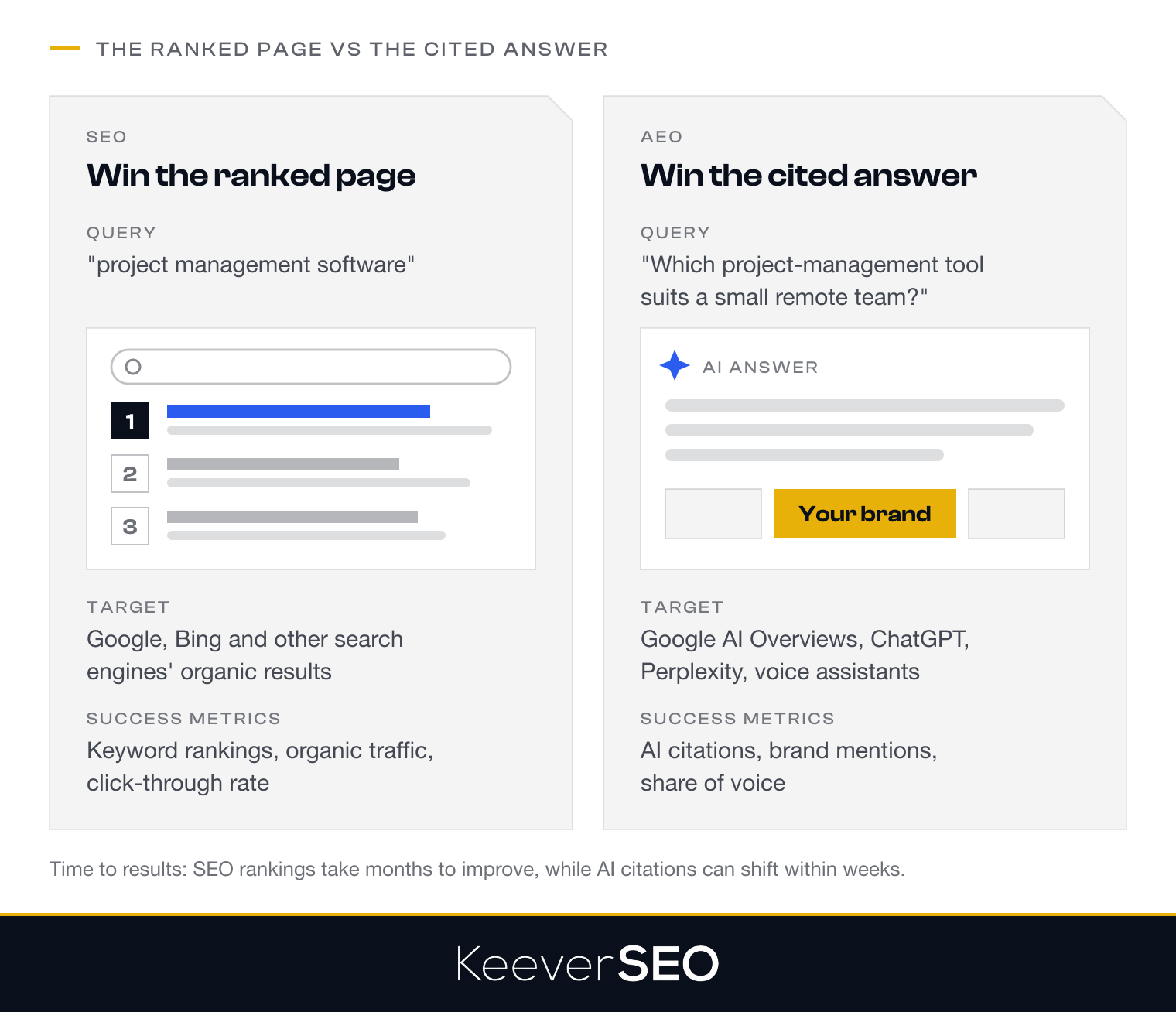
AEO prioritizes direct answers, structured content, and visibility in AI-generated responses. SEO prioritizes relevant pages, strong technical foundations, and organic rankings, and the sections below compare how each approach handles those dimensions.
How Do AEO and SEO Differ in Search Intent and Query Format?
AEO and SEO differ in search intent and query format because AEO targets conversational questions and detailed prompts, while SEO targets shorter keyword queries. An AEO query might ask, "Which project-management tool suits a small remote team?" while an SEO query might use the phrase "project management software."
AEO structures content to answer focused questions directly. SEO uses keyword research to match broader informational, commercial, transactional, or navigational intent and rank relevant pages in organic results, and both approaches should address the searcher's underlying need.
How Do AEO and SEO Differ in Target Platforms?
AEO and SEO differ in target platforms because AEO targets answer platforms such as Google AI Overviews, ChatGPT, Perplexity, and voice assistants. AEO helps answer platforms select and cite clear information in generated or spoken answers.
SEO targets organic search results on platforms such as Google and Bing. SEO improves webpage visibility in ranked listings, where searchers click through to the source.
How Do AEO and SEO Differ in Content Format?
AEO and SEO differ in content format because AEO content uses answer-first passages that give direct responses to focused questions. Question-based headings, concise explanations, lists, and tables help answer engines extract clear information.
SEO content develops a topic through in-depth, keyword-targeted pages. Detailed explanations, examples, and related subtopics help SEO pages address broader search intent and rank in organic results.
How Do AEO and SEO Differ in Technical Requirements?
AEO and SEO differ in technical requirements because AEO focuses on making content accessible and easy for answer engines to interpret. Clear page text and accurate structured data help systems interpret content, but "there are no additional requirements to appear in AI Overviews or AI Mode, nor other special optimizations necessary," according to Google's "AI features and your website." OpenAI's "Overview of OpenAI Crawlers" states that "sites that are opted out of OAI-SearchBot will not be shown in ChatGPT search answers," so site owners must allow OAI-SearchBot when they want ChatGPT search to find their pages.
SEO technical requirements focus on crawlability, indexing, and site performance. Search engines need access to important pages, logical internal links, and fast-loading pages, and AEO builds on those foundations rather than replacing them.
How Do AEO and SEO Differ in Success Metrics?
AEO and SEO differ in success metrics because AEO measures whether answer engines cite or mention a brand in generated responses. The main AEO metrics are citation frequency, share of voice across tracked prompts, and brand mentions.
SEO measures how pages perform in organic search results. Rankings show page positions, organic traffic counts unpaid search visits, and click-through rate measures how frequently searchers click a result.
How Do AEO and SEO Differ in Time to Results?
AEO and SEO differ in time to results because AEO citations can change within days or weeks after content updates, while SEO rankings take months to improve. AI platforms recrawl and reassess sources quickly, but citation timing varies by platform, query, and site authority.
"Only 1.74% of newly published pages rank in the top 10 within a year (down from 5.7% in 2017)," according to "How Long Does It Take to Rank in Google? And How Old Are Top Ranking Pages?" by Patrick Stox, published by Ahrefs in May 2025, and the average #1 ranking page in that study is 5 years old. SEO therefore builds more gradually, while AEO visibility shifts faster and fluctuates more.
Where Do AEO and SEO Overlap?
AEO and SEO overlap through useful content, technical health, authority, and alignment with search intent. Answer engines cite pages that rank in traditional search, although strong organic rankings do not guarantee an AI citation.
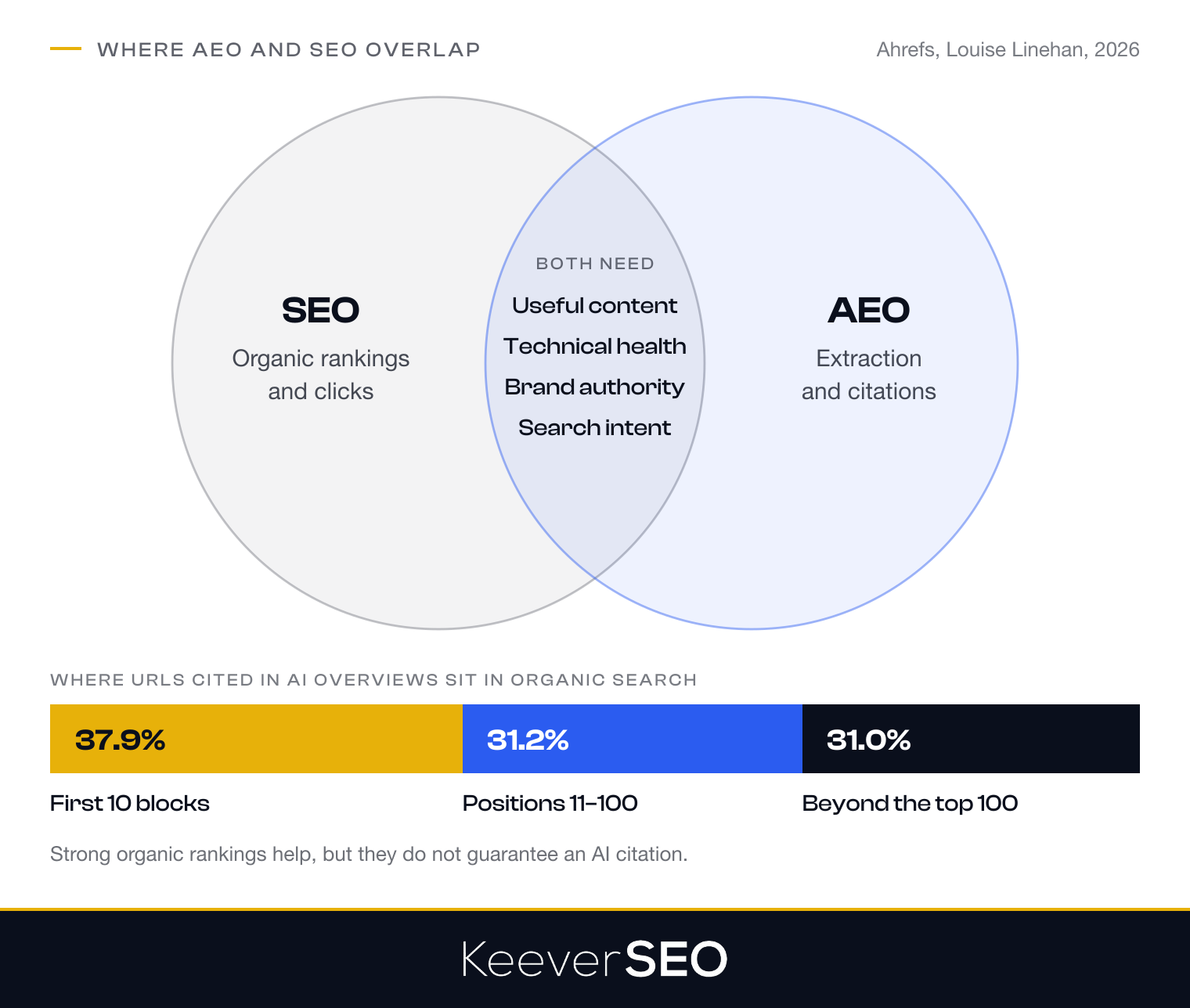
A 2026 Ahrefs study, "Update: 38% of AI Overview Citations Pull From The Top 10" by Louise Linehan, found that "37.9% of URLs cited in AI Overviews also appeared within the first 10 blocks," while the rest split between positions 11 to 100 (31.2%) and beyond the top 100 (31.0%). The Ahrefs data shows meaningful overlap between AI citations and organic visibility, and confirms that answer engines cite many pages outside the top organic results.
Does AEO Replace SEO?
No, AEO does not replace SEO, because AEO builds on SEO by helping answer engines find and cite accessible, indexed pages. Google describes AEO and GEO as "still SEO" from its perspective, according to "Google's Guide to Optimizing for Generative AI Features on Google Search," published by Google Search Central in May 2026. Search engines and AI answer tools rely on crawlable content, relevance, and authority to retrieve useful information. SEO supports organic rankings and discoverability, while AEO structures content for direct answers and AI citations, and the related myth that AEO means adding an FAQ section oversimplifies the work in the same way.
Is AEO Just Adding an FAQ Section?
No, AEO is not just adding an FAQ section, because answer engine optimization structures clear answer passages, applies accurate schema to visible content, strengthens topical authority, and earns credible off-site brand mentions. FAQ content supports AEO, but an FAQ section does not replace the broader optimization practices.
When Should a Business Prioritize AEO vs SEO?
A business should prioritize SEO when it needs stronger rankings, organic traffic, or local search visibility, and AEO when it has a sound SEO foundation and its customers use AI tools to research question-led topics.
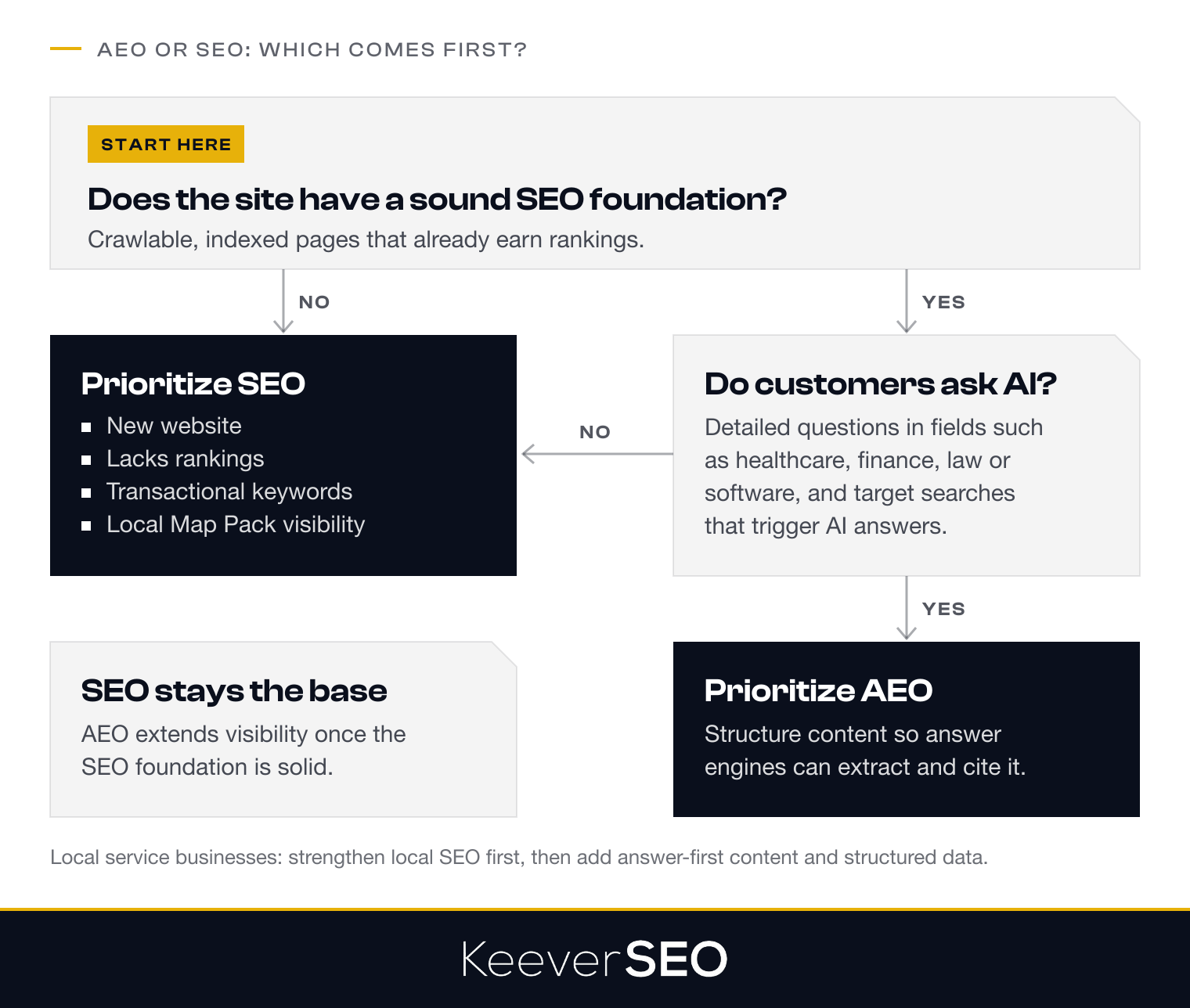
The right balance depends on current search visibility, customer behavior, and business goals. The sections below explain when AEO or SEO deserves greater focus.
When Should a Business Prioritize AEO?
A business should prioritize AEO when customers ask detailed questions in areas such as healthcare, finance, law, education, or software. AEO deserves greater focus when target searches trigger Google AI Overviews or other AI-generated answers. Businesses with crawlable, indexed pages and a solid SEO foundation can then structure content to provide direct, reliable answers.
When Should a Business Prioritize SEO?
A business should prioritize SEO when its website is new, lacks rankings, or targets transactional keywords. Product and service pages attract high-intent visitors searching for a purchase or booking. Local service businesses should focus on local SEO, accurate business information, reviews, and Google Business Profile optimization to improve Map Pack visibility, and AEO extends visibility after the business establishes a solid SEO foundation.
How Do You Optimize for Both AEO and SEO?
To optimize for both AEO and SEO, follow a three-step process: audit existing pages, structure useful content for direct answers, and build authority. The process preserves SEO foundations while helping AI answer engines interpret and cite relevant information.
The optimization process checks which pages rank, improves question-and-answer formatting and accurate schema, then earns credible backlinks and third-party mentions. The first step is an AI-readiness audit of existing SEO content.
1. Audit Existing SEO Content for AI Readiness
Auditing existing SEO content for AI readiness identifies the pages that can earn visibility in both organic results and AI answers. Review which pages already rank for relevant queries, then check whether each page answers its target question directly near the beginning and supports the answer with accurate, useful detail.
Compare those rankings and organic visits with citations and brand mentions across relevant AI search platforms. "To be eligible to be shown as a supporting link in AI Overviews or AI Mode, a page must be indexed and eligible to be shown in Google Search with a snippet," according to Google's "AI features and your website," and Google requires no special AI-only markup. Record gaps such as buried answers, unclear headings, weak sourcing, or inaccessible content, then use the audit findings to restructure priority pages.
2. Structure Pages With Q&A Formatting and Schema
Structuring pages with Q&A formatting and schema helps AEO and SEO pages match search queries and present answers in a clear format. Place a concise, factually complete answer beneath each heading, then add supporting details, examples, or evidence. Lists and tables make information easier for search engines and AI systems to interpret.
Use Article schema to describe article details and FAQPage schema only for visible question-and-answer content, keeping in mind that Google stopped showing FAQ rich results in May 2026. Structured data must match the page, and markup does not guarantee AI citations or rich search results. Once revised pages present clear answers and accurate schema, build their authority through digital PR and backlinks.
3. Build Authority With Digital PR and Backlinks
Building authority with digital PR and backlinks supports both SEO rankings and AEO citations. Backlinks from relevant, reputable websites strengthen organic visibility, while independent brand mentions help answer engines identify a brand and its subject knowledge.
Earn backlinks through original research, expert contributions, useful industry resources, partnerships, and digital PR. Seek accurate coverage in reputable publications, trade media, and review sites rather than manufacturing mentions. Track ranking changes and qualified organic traffic alongside AI citations and unlinked brand mentions.
Which Matters More for Local Service Businesses: AEO or SEO?
SEO matters more for local service businesses today, because Google Search, Google Business Profiles, and the Map Pack still connect most nearby customers with providers. AEO is gaining ground fast: use of ChatGPT and other generative AI tools for local recommendations rose "from 6% last year to 45%," according to the "Local Consumer Review Survey 2026" by Rosie Murphy, published by BrightLocal in February 2026.
AEO extends local visibility to service questions answered by AI, such as "How much does a plumber cost?" Local businesses should strengthen local SEO first, then add answer-first content and structured data to raise their chances of appearing in AI answers.
How Can Businesses Evaluate an Agency That Handles Both AEO and SEO?
Businesses can evaluate an agency that handles both AEO and SEO by reviewing separate, connected reports. SEO reporting should track rankings, organic traffic, click-through rates, conversions, and technical health, and AEO reporting should track AI citations, brand mentions, answer-engine visibility, and the prompts producing those appearances. Agencies should explain measurement methods, timelines, past work, and expected outcomes without guaranteeing rankings or citations, in line with Google's "Do You Need an SEO? Tips for Hiring an SEO," which states that "no one can guarantee a #1 ranking on Google."
A documented content and technical process should cover query research, direct answers, internal links, crawlability, and accurate structured data. The agency should validate schema against visible page content and disclose how it earns backlinks, digital PR placements, and relevant third-party mentions.
How Does Keever SEO Combine Answer Engine Optimization With SEO?
Keever SEO combines answer engine optimization with SEO by pairing traditional ranking work with AI visibility work across search results and AI-generated answers. The AEO and SEO agency approach pairs keyword targeting, technical and on-page improvements, and organic-position tracking with an AI visibility audit across ChatGPT, Perplexity, Gemini, and Google AI Overviews.
The Keever SEO AEO work maps question-focused topics, structures answer-first content, optimizes entities, and adds relevant schema markup. Keever SEO tracks AI citations, brand mentions, share of voice, and AI referral traffic alongside keyword rankings and organic traffic.
How Do AEO and SEO Relate to GEO and AI Search?
AEO and SEO relate to generative engine optimization (GEO) and AI search as connected approaches to online visibility. SEO helps search engines find and rank web pages, while AEO structures content for direct answers and GEO builds brand visibility in generated responses. AI search systems synthesize information from multiple sources and display citations instead of only ranked links. The sections below compare AEO with GEO, explain how AI search differs from traditional search, and describe how zero-click searches shift visibility toward answers.
Is AEO the Same as GEO?
AEO is not exactly the same as GEO, since the two overlap heavily but stress different outcomes. Answer engine optimization focuses on structuring content for extraction as a direct answer, while generative engine optimization focuses on earning inclusion or citation in AI-generated responses.
How Does GEO Differ From Traditional SEO?
GEO differs from traditional SEO because generative engine optimization aims to get a brand or source included in AI-generated answers, while traditional SEO aims to rank webpages in search results and earn organic clicks. GEO focuses on brand authority and citations in synthesized responses, and SEO focuses on crawlability, relevance, and ranking position.
How Do AI Search Engines Differ From Traditional Search Engines?
AI search engines differ from traditional search engines because AI search engines synthesize information from multiple sources into direct answers with citations or links. Traditional search engines rank webpages in a list, leaving users to compare results and open relevant pages.
How Do Zero-Click Searches Shift Value From SEO to AEO?
Zero-click searches shift value from SEO to AEO by moving value from website clicks to brand visibility within AI Overviews, featured snippets, and other search answers. "In the first four months of 2026, a whopping 68.01% of Google searches ended without a click," according to "In 2026, Less than One Third of Google Searches Still Send a Click" by Rand Fishkin, published by SparkToro in June 2026 using US Similarweb panel data. The rise in clickless searches explains why businesses track answer citations and mentions alongside organic traffic.
Which AEO Strategies Build on an Existing SEO Foundation?
The AEO strategies that build on an existing SEO foundation improve pages that already rank rather than replacing their search foundation. Restructure ranking pages with question-style headings, concise answer-first passages, and scannable lists or tables to help answer engines extract the right information. Add accurate Article schema, and FAQPage schema where visible questions exist, that matches page content while preserving crawlability and internal links. Relevant backlinks support organic rankings, while credible third-party brand mentions strengthen AI citation opportunities.
What Is the Final AEO vs SEO Verdict?
The final AEO vs SEO verdict is that SEO should remain the foundation, while AEO adds visibility inside AI-generated answers. SEO helps pages earn organic rankings and clicks, and AEO structures useful content to raise its chances of being extracted, cited, and mentioned by answer engines.
Businesses do not need to choose one strategy over the other. SEO supports discoverability across traditional search results, while AEO extends visibility to AI answers, which makes the two approaches work together in the AEO versus SEO comparison.