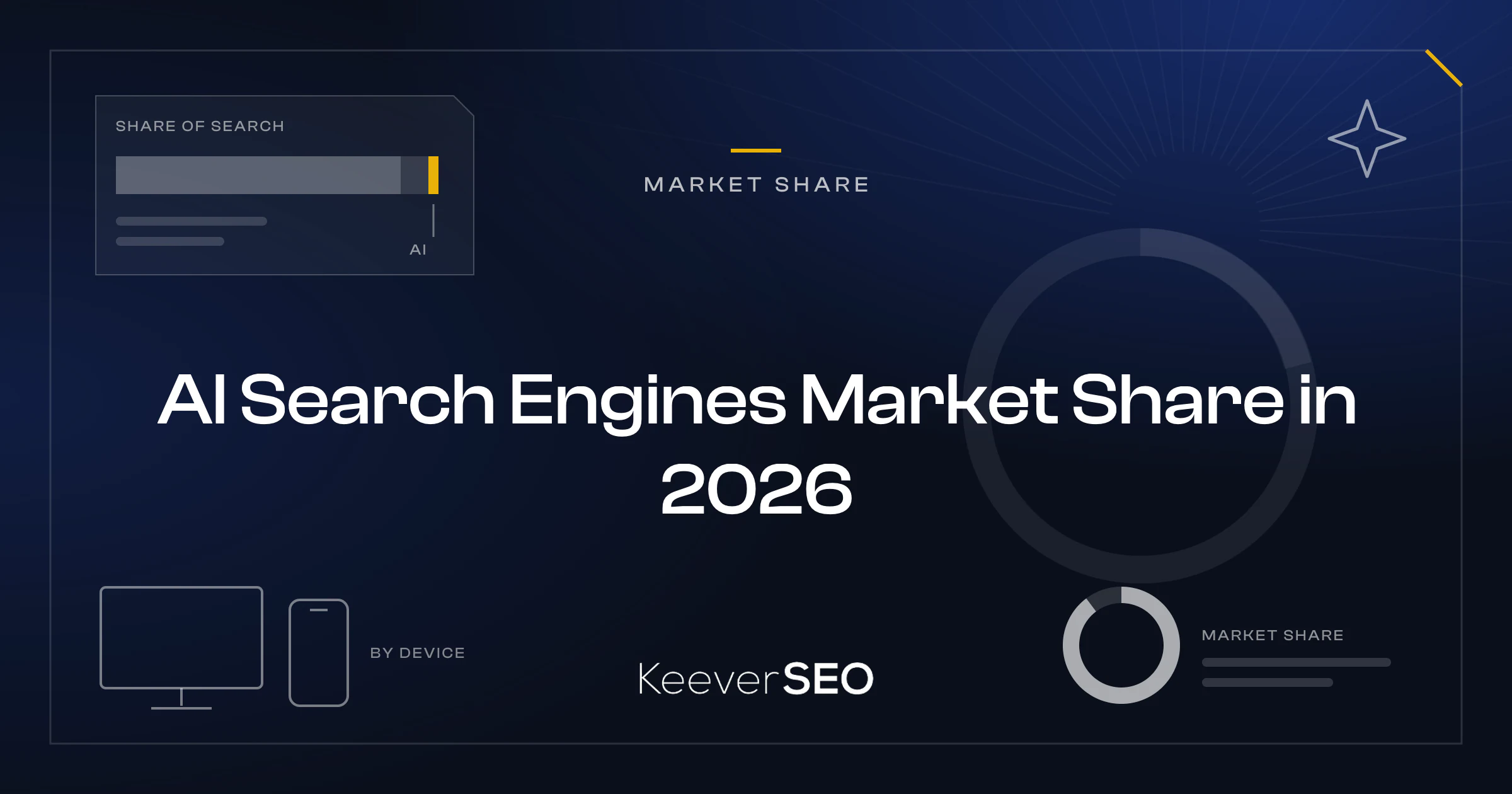
AI search engines still hold a small share of total search compared with Google, while ChatGPT leads AI tools by users and referral traffic. AI search market share measures the proportion of users, queries, or website referrals associated with each search engine or assistant, and those measures produce different results. In September 2026, Google held 89.94% of worldwide search engine referrals, compared with Bing at 5.29%, Yahoo at 1.36%, Yandex at 1.31%, DuckDuckGo at 0.74%, and Baidu at 0.44%, according to Statcounter Global Stats, and desktop and mobile shares vary by device.
Within AI platforms, Similarweb data puts ChatGPT at roughly 53% of generative AI website visits in May 2026, with Gemini at around 27 to 28%. Referral share gives a different picture: SE Ranking attributes 74.78% of AI referral traffic to ChatGPT and 7.23% to Perplexity, while Google AI Overviews reach users within Google Search rather than functioning as a separate referral source. Country and device differences matter, since Google leads in the United States, while Yandex leads in Russia and Baidu leads in China. Figures vary because datasets count different panels, visits, queries, devices, and AI products, and generative AI platform visits rose 70% year over year to about 9.5 billion per month between June 2025 and May 2026, without an equivalent loss in Google's search share.
For local service businesses, Google remains the main source of search visibility and leads, while AI assistants offer a growing discovery and referral channel. Businesses can maintain Google SEO while building AI visibility, comparing engine features, tracking AI referrals, and assessing how generated answers and zero-click searches affect website visits. The sections below separate those measures and begin with the question of how AI search market share is calculated.
What Is the Market Share of AI Search Engines?
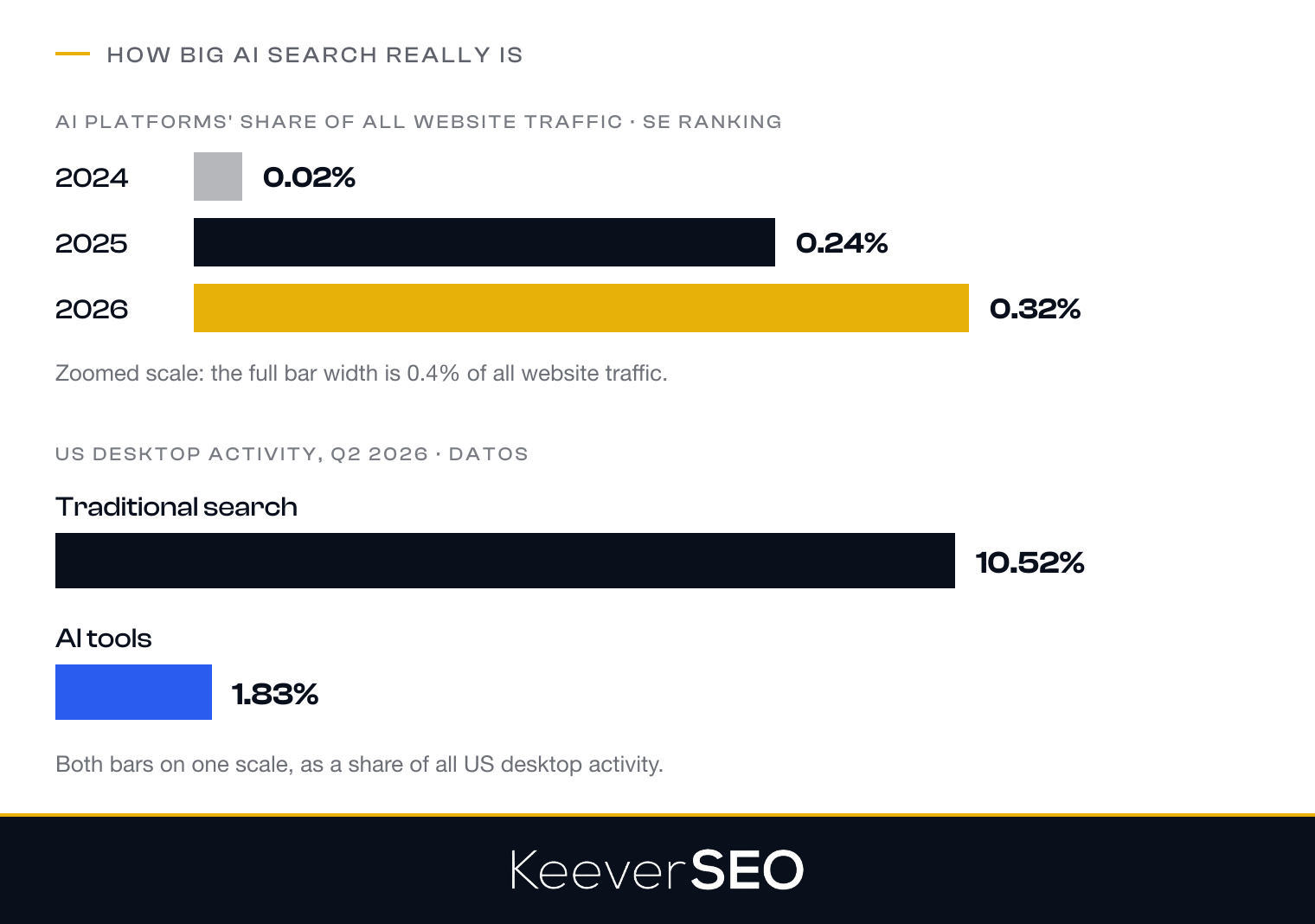
The market share of AI search engines is small: AI platforms account for "0.32% of all website traffic, up from 0.24% in 2025 and 0.02% in 2024," according to "Analysis of Top AI Search Engines: Who Is Catching Up to ChatGPT?" by Yulia Deda, published by SE Ranking in June 2026. Datos reports that AI tools reached 1.83% of US desktop activity in Q2 2026, compared with 10.52% for traditional search, in its "State of Search Q2 2026."
User share produces a different comparison from website referrals. Similarweb's "AI Search Stats 2026: Market Share, Referral, and Citation Data" (July 2026) estimated ChatGPT at roughly 53% of generative AI website visits by May 2026, with Gemini at around 27 to 28%, and those figures measure visits to AI assistant websites, not all search queries or total search market share.
How Much Search Market Share Does Google Still Hold?
Google still holds 89.94% of the worldwide search engine market in Statcounter's September 2026 data. The figure places Google far ahead of Bing, which holds 5.29% globally. Statcounter bases the figure on search engine referrals, not on the number of searches performed, so the percentage does not count every search query.
What Is the Global Search Engine Market Share Breakdown?
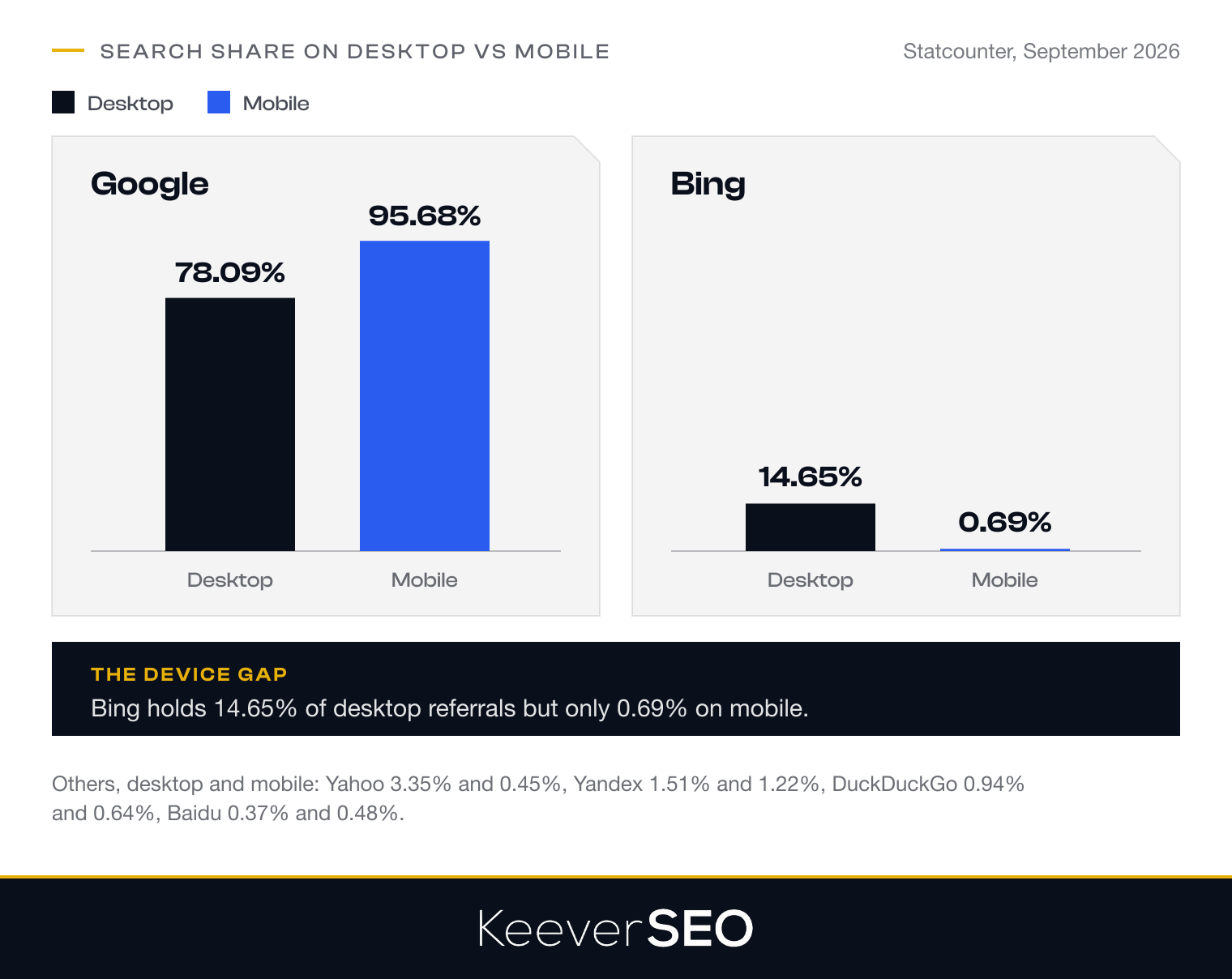
The global search engine market share breakdown puts Google at 89.94% worldwide, well ahead of Bing at 5.29%. Statcounter's September 2026 data shows that search engine share varies by device, with Google stronger on mobile and Bing stronger on desktop.
| Search Engine | Worldwide Share | Desktop Share | Mobile Share |
|---|---|---|---|
| 89.94% | 78.09% | 95.68% | |
| Bing | 5.29% | 14.65% | 0.69% |
| Yahoo | 1.36% | 3.35% | 0.45% |
| Yandex | 1.31% | 1.51% | 1.22% |
| DuckDuckGo | 0.74% | 0.94% | 0.64% |
| Baidu | 0.44% | 0.37% | 0.48% |
Source: Statcounter Global Stats, September 2026.
What Is Bing's Search Market Share?
Bing's search market share is 5.29% worldwide in Statcounter's September 2026 data, ranking second behind Google at 89.94%. Microsoft Bing supports web search in Copilot and serves as a search source for ChatGPT Search. Bing's conventional search share measures search engine activity, not ChatGPT or Copilot usage.
How Do DuckDuckGo, Yahoo, and Yandex Compare?
DuckDuckGo, Yahoo, and Yandex compare closely worldwide, with Yahoo at 1.36%, Yandex at 1.31%, and DuckDuckGo at 0.74% in Statcounter's September 2026 estimates. DuckDuckGo has a stronger US presence, with 1.75% of US search referrals, and Yahoo reaches 2.63% in the United States. Yandex is strongest in Russia, where it holds 70.35%, compared with Google's 28.1%.
What Is the Market Share of AI Chatbots and Answer Engines?
The market share of AI chatbots and answer engines is led by ChatGPT, with 80.47% worldwide in September 2026. Statcounter's AI chatbot market share dataset places Google Gemini second with 10.94%, followed by Perplexity at 5.84%, Microsoft Copilot at 1.78%, and Claude at 0.95%.
The figures cover standalone chatbots, not each platform's share of all searches. Google's AI Overviews appear within Google Search, so their reach is not represented by Gemini's standalone chatbot share.
How Much of the AI Search Market Does ChatGPT Hold?
ChatGPT holds 80.47% of the AI chatbot market on Statcounter's September 2026 data and 56.4% of generative AI website traffic on Similarweb data for the same month, as reported by OfficeChai in October 2026. ChatGPT's Similarweb share fell from about 76% in June 2025 to roughly 53% by May 2026 before recovering, climbing from 54.3% in July to 56.4% in September. The two figures come from different metrics, so they should not be compared directly.
How Much AI Search Share Do Gemini and Google AI Overviews Hold?
Gemini holds about 25% of generative AI website traffic on Similarweb data for September 2026, and Google reports that "the Gemini app is now at one billion users" in its Q3 2026 earnings remarks. Google reported that AI Overviews has "over 2 billion monthly users" in July 2025. Gemini's visit share and AI Overviews' reach measure different activity, so they should not be added together as a single market share figure.
How Much AI Search Share Do Perplexity, Copilot, and Claude Hold?
Perplexity, Copilot, and Claude hold 5.84%, 1.78%, and 0.95% of the AI chatbot market in Statcounter's September 2026 data. Perplexity declined from 10.85% in September 2025, while Claude reached 3.74% in June 2026 before falling back. Similarweb's September 2026 traffic data shows a different order, with Claude at 9.6% and Copilot at 1.5%, so each percentage belongs to its own dataset.
Which AI Platforms Send the Most Referral Traffic to Websites?
The AI platform that sends the most referral traffic to websites is ChatGPT. SE Ranking's June 2026 analysis reports that "ChatGPT leads with 74.78% of AI referral traffic, followed by Gemini at 11.56%, Perplexity at 7.23%, Copilot at 3.51%, and Claude at 2.62%," and puts ChatGPT's share down from 79.74% in 2025 even as its actual traffic grew 27%.
Referral share measures clicks sent to websites, not total user reach. ChatGPT's own citation behavior is changing too, since Similarweb reports "the presence of citations in US ChatGPT prompts rising from about 1.6% in June 2025 to roughly 6.8% by May 2026." Rankings vary by study and audience, so compare referral shares only within one dataset.
How Does Search Market Share Differ by Country and Device?
Search market share differs by country and device: Google leads globally, while desktop use gives Bing and other engines a larger share. Statcounter's September 2026 data puts Google at 89.94% worldwide across devices, compared with 78.09% on desktop and 95.68% on mobile, and Bing reaches 14.65% of desktop referrals.
Local search engines lead in some national markets. Baidu held 46.85% of China's search market in September 2026, while Yandex remains Russia's leading engine, so global averages may not reflect the best platform for a given country.
What Is the Search Engine Market Share in the United States?
The search engine market share in the United States is 85.19% for Google and 9.91% for Bing in Statcounter's September 2026 data. Yahoo accounted for 2.63%, DuckDuckGo for 1.75%, Yandex for 0.33%, and Ecosia for 0.12%. Statcounter's US data measures referral share, not exclusive user preference.
Why Do Market Share Figures Differ Between Sources?
Market share figures differ between sources because research providers measure different activities and use different data sources. User panels estimate behavior from sampled users, while page-tag datasets such as Statcounter record search referrals on participating websites.
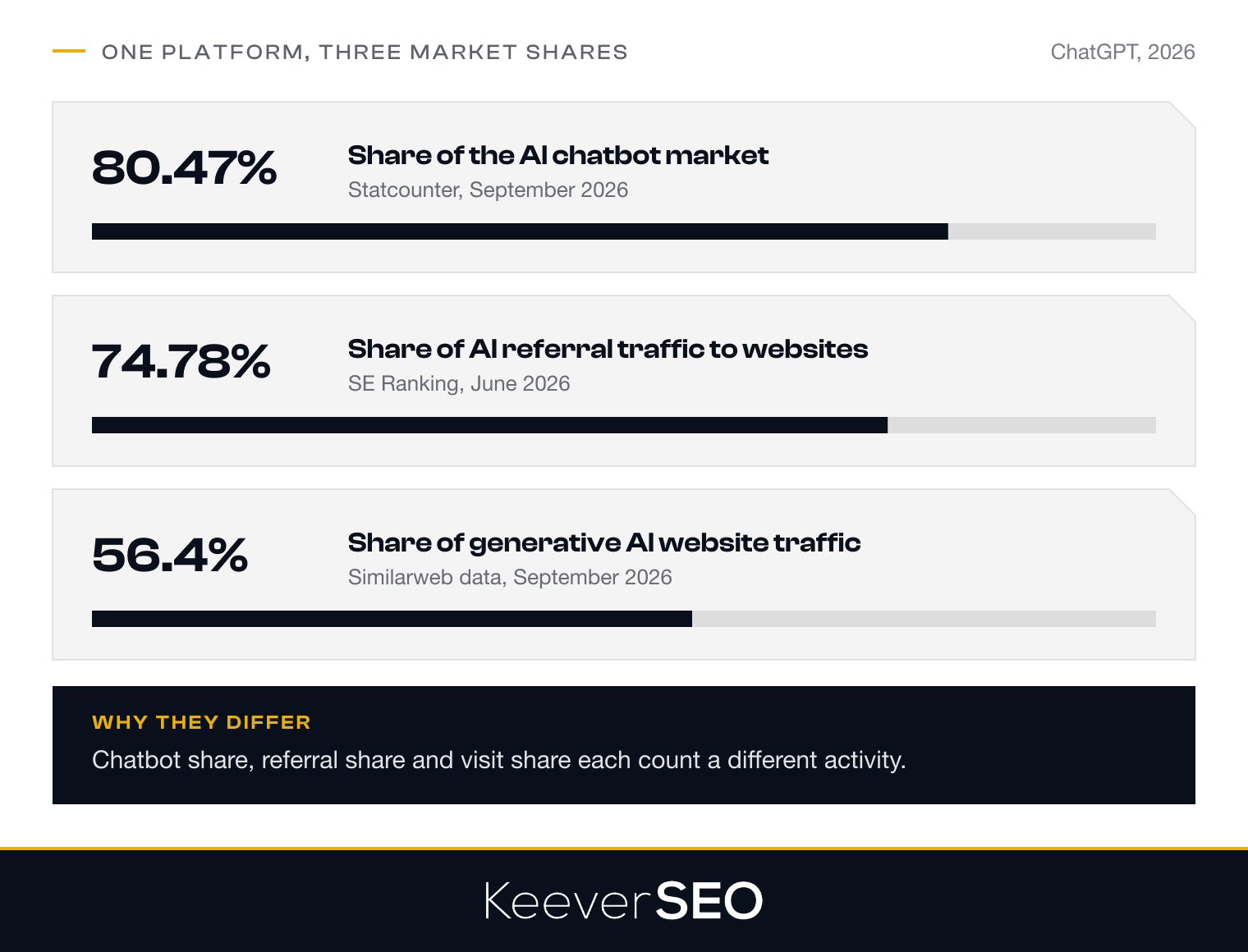
Search queries, website visits, and outbound clicks represent separate measurements. Referral datasets miss searches that end without a website click, while AI search reports may count standalone chatbots, embedded search features, or both. Comparisons are most reliable when they use the same metric, source, and date range.
How Fast Is the AI Search Engine Market Growing?
The AI search engine market is growing at an annual rate of about 14% in published forecasts, although market size estimates vary widely by definition. Grand View Research estimates that the global market was "USD 16.28 billion in 2024" and will reach "USD 50.88 billion by 2033," a 13.6% CAGR, in its "AI Search Engine Market Size, Share" report, while Coherent Market Insights expects "USD 49.83 Billion in 2026" rising to "USD 110.52 Billion by 2033." The forecasts describe spending on AI search technology, not a directly measured increase in AI engines' share of search queries.
Is Google Losing Search Market Share to AI?
No, Google is not losing substantial search market share to AI, based on current data. Statcounter measured Google's worldwide share at 89.94% in September 2026, compared with 90.82% in December 2025 and 91.32% in July 2026, so the share moves around the 90% line rather than falling in one direction. Google reports that its "year-over-year query growth rate is the highest it's been in the last five years." AI assistants are changing how people search and directing some referral traffic, but available market share data does not establish that AI caused a material decline in Google's share.
What Does AI Search Market Share Mean for Local Service Businesses?
AI search market share means that Google still drives most local service leads, while AI search engines become a growing discovery channel. SOCi's Local Visibility Index 2026 reports that ChatGPT recommends 1.2% of multi-location brand locations, against 35.9% appearing in Google's 3-Pack.
BrightLocal's "Local Consumer Review Survey 2026" reports that "use of ChatGPT and other generative AI tools for local recommendations has grown rapidly, rising from 6% last year to 45%." Local businesses should maintain accurate Google Business Profiles while building credible service information, reviews, and mentions that AI assistants can find.
Where Should a Business Invest as AI Search Share Grows?
A business should invest in Google SEO first as AI search share grows, while adding measured work on AI search visibility. Crawlability, indexability, helpful content, and accurate business information support visibility in both traditional results and Google's AI features.
A 70 to 80% focus on core SEO and a 20 to 30% test budget for AI visibility can provide a starting point. Businesses should revise that balance using customer search behavior, referral visits, citations, and conversion data.
How Does Keever SEO's AI Optimization Service Win Visibility Across Growing AI Search Engines?
Keever SEO's AI optimization service wins visibility across growing AI search engines by combining Answer Engine Optimization (AEO) and Generative Engine Optimization (GEO) across ChatGPT, Gemini, Perplexity, Google AI Overviews, Copilot, and Claude. A GEO-ready SEO agency AI visibility audit identifies existing brand mentions and citations, then compares them with traditional search rankings.
The service strengthens AI visibility through answer-focused content, entity optimization, schema markup, structured data, and relevant third-party mentions. Ongoing tracking monitors platform citations, brand mentions, sentiment, and share of voice to measure visibility changes over time.
How Do AI Search Engines Compare Beyond Market Share?
AI search engines compare beyond market share in citation style, web access, and the tasks they support. ChatGPT Search provides conversational answers with clickable web citations, while Perplexity centers on source-linked research and source inspection. Google's AI features connect generated summaries with Google Search, Maps, shopping, and news, Copilot fits Microsoft productivity workflows, and Gemini supports multimodal tasks across Google services. Claude suits document analysis and drafting, and users of any engine should verify citations and check the sources behind AI-generated answers.
How Do AI Search Engines Differ From Traditional Search Engines?
AI search engines differ from traditional search engines by generating conversational answers that gather and summarize information from multiple sources, with citations in most products. Traditional search engines rank webpages in a list, leaving users to open and compare links themselves.
How Do AI Overviews Change Google's Traffic Share?
AI Overviews change Google's traffic share by answering some queries directly on the results page, which keeps more search activity on Google and reduces clicks to websites. Pew Research Center found that users clicked a traditional result in 8% of visits when an AI summary appeared, compared with 15% when no summary appeared, and clicked a link inside an AI summary in just 1% of visits, according to "Google users are less likely to click on links when an AI summary appears in the results" by Athena Chapekis and Anna Lieb, July 2025.
How Do You Measure AI Referral Traffic in Analytics?
To measure AI referral traffic in analytics, filter reports for sources such as ChatGPT, Perplexity, Gemini, Copilot, and Claude. In GA4, compare each source's sessions, engagement, conversions, and landing pages, then group identified sources into a custom "AI assistants" channel. Referral tracking misses some visits when apps, privacy settings, or copied links remove referrer data, and Google AI Overviews clicks appear within Google's organic search traffic.
How Do Zero-Click Searches Affect Traffic Share?
Zero-click searches affect traffic share by reducing website visits even when search volume stays steady, because users get answers on the results page without opening a website. "In the first four months of 2026, a whopping 68.01% of Google searches ended without a click," according to "In 2026, Less than One Third of Google Searches Still Send a Click" by Rand Fishkin, published by SparkToro in June 2026 using US Similarweb panel data.
What Will AI Search Engine Market Share Look Like Next?
AI search engine market share will likely keep growing over the next several years, while traditional search remains dominant. Grand View Research projects the global AI search engine market will reach USD 50.88 billion by 2033, although the revenue forecast signals industry expansion and does not directly predict AI's share of search queries.
AI search growth points toward a blended search market, not an immediate replacement for Google. Current figures still show Google leading conventional search, while ChatGPT leads AI platforms by users and referral traffic.